
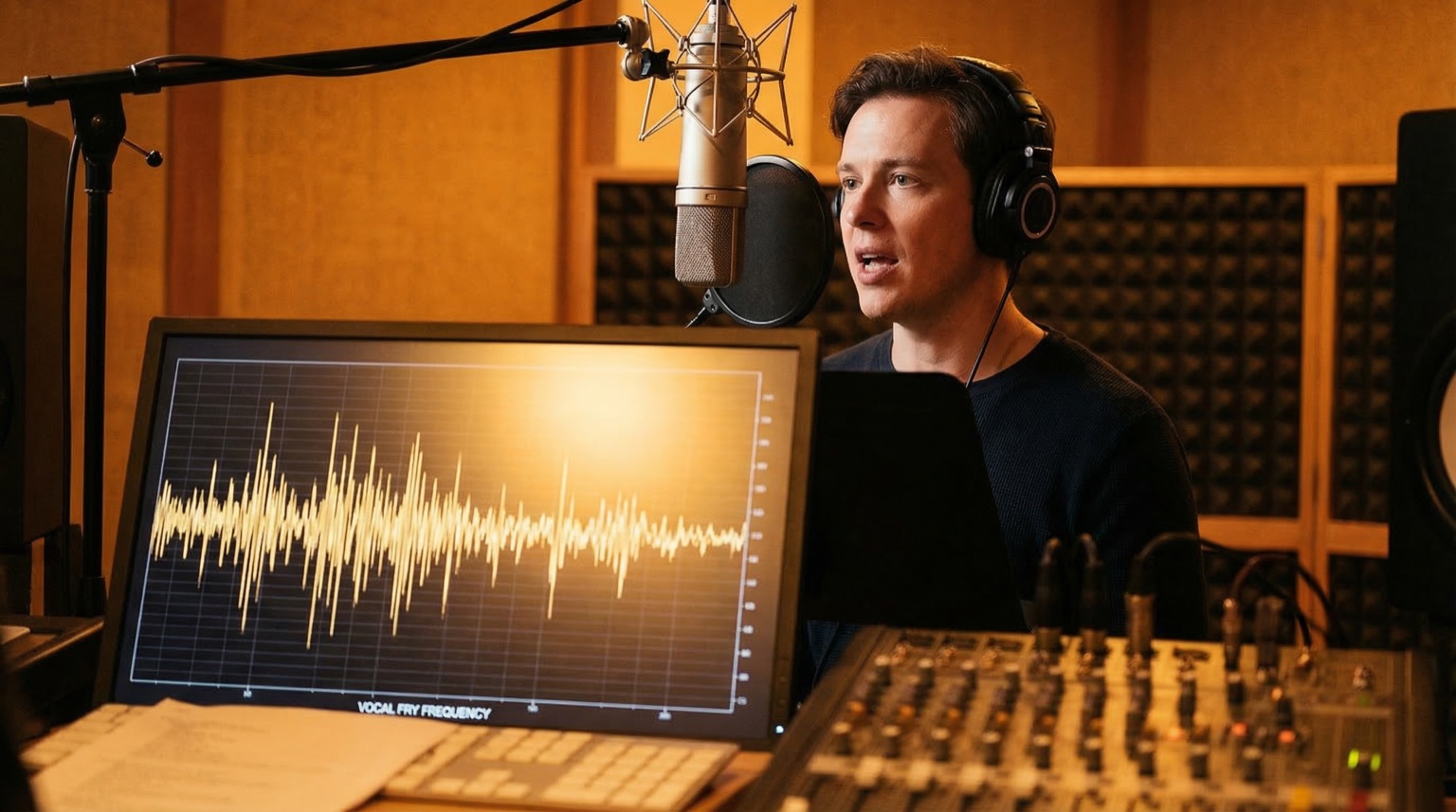
Vocal fry went from podcast irritation to deliberate stylistic choice in advertising. But most people using it in commercial material do not understand what it signals — and the result damages more often than it helps.
Key points at a glance
- Vocal fry in advertising is not the same as vocal fry from fatigue or poor technique. It is deliberate signalling.
- In the right context (intimacy, authenticity, youthful tone) it can work. In the wrong context (authority, credibility, broad audience) it undermines the message.
- The audience's age and cultural context determine how fry is interpreted. Under 30: neutral or positive. Over 45: negative.
- Technically: controlled fry requires more precision, not less. It is harder to do well than clean phonation.
- The "conversational tone" trend in advertising has become standard — but fry is not synonymous with conversational tone.
- This article complements vocal fry in voice-over: technical definition and management with a focus on advertising and media applications.
From irritation to stylistic tool
Vocal fry gained its modern notoriety through podcasts around 2015. Listeners complained. Articles were written. Linguists explained it was a socio-phonetic phenomenon, not a defect. The debate focused mostly on how young women spoke — which was both unfair and misleading, since fry occurs across all genders and ages.
What happened next was more interesting. Advertising agencies and creative teams began using fry deliberately. Not as an accident, but as a tool. The logic was simple: if authenticity sells, and fry signals a relaxed, unpolished voice — then fry should sell.
And sometimes it does. But that logic has several serious holes.
I have been recording commercials in various formats since the 1980s. The trend toward more conversational delivery in advertising is real. But there is a critical distinction between conversational tone and vocal fry. Conversational tone is about pace, proximity, word choice and energy. Fry is about phonation — how the vocal cords vibrate. You can achieve perfect conversational tone without a single second of fry. And you can have fry without sounding the least bit conversational.
Conflating the two is the most common mistake I see in commercial production today.
There is also a generational divide in how fry is used deliberately. Younger creatives who grew up with the podcast format hear fry as a natural part of storytelling. They write scripts that assume fry in the delivery without specifying it — it lives in their internal ear. Older producers hear the same delivery and react with "why does it sound broken?" Both are correct within their own frame of reference. But neither has analysed whether the target audience shares their perception.
I see this most clearly in casting. An agency sends three reference clips — all with prominent fry. But the brief says "natural, credible, warm." Fry is not mentioned. When I deliver a take with clean phonation and conversational tone, the feedback is that it "lacks edge." What it lacks is not edge. What it lacks is fry. But they do not have the vocabulary to say so, because they have not separated the technique from the overall tone.
When vocal fry works in advertising
There are scenarios where vocal fry genuinely adds something. They share common characteristics.
Intimacy. If the message requires the listener to feel closeness — a personal story, direct address, a sensitive product — controlled fry at the end of phrases can create that effect. It works in the format of "a person telling you something" rather than "a brand informing you." Fragrance, fashion, artisanal food brands: that is the territory.
Young target audience. Listeners under 30 have grown up with fry as a neutral part of spoken language. They do not filter it out and they do not react negatively. For them, it signals that the speaker is not "performing" — which in certain contexts reads as honesty.
Short format. A 15-second pre-roll or an Instagram reel tolerates fry better than a 60-second television spot. Short format has lower demands on sustained clarity. The listener does not need to follow along for 50 seconds — and the effect of fry as "honest tone" lands before fatigue sets in.
Contrast. Fry works when it is contrasted against clean phonation. One line with fry followed by a clear, driven closing line creates dynamic range. It becomes a stylistic device rather than a defect.
But note: in all these cases, fry is controlled, brief and deliberately placed. It is not a voice that creaks throughout. It is an effect.
When vocal fry damages the message
And here is where it more frequently lands.
Authority and credibility contexts. Banking, insurance, legal, public sector, healthcare. If the listener needs to trust what is being said — not just feel it — fry undermines the message. Research (including Anderson's work at Duke University, 2014) shows that voices with sustained vocal fry are judged as less competent, less trustworthy and less hireable. This holds true even among listeners who themselves use fry in their own speech.
Broad audience. If your advertisement targets ages 25–65, half the audience reacts neutrally and the other half reacts negatively. That is not a risk worth taking for a stylistic choice. In those projects, you want clean phonation with conversational tone — not fry.
Long format. E-learning, training films, documentaries, corporate video. Sustained fry creates listener fatigue. The ear works harder with irregular vibrations, and after five minutes the listener starts losing focus. In 20-minute material, it is destructive.
International markets. Vocal fry as a stylistic device is primarily an English-language phenomenon. In Scandinavia it exists, but it is more often interpreted as fatigue or disinterest than as authenticity. In German, French and Asian markets, it can be perceived as directly negative.
Telephone channels. IVR systems and phone trees compress audio. Fry that sounds acceptable in the studio can become unintelligible through telephone compression. The technical interface amplifies the problem.
How different audiences interpret vocal fry
The reaction to vocal fry is not universal. It varies with age, gender, cultural background and context. Here is what research and my own experience show.
Under 25. Neutral to positive. Fry is normalised in this group. They react more to energy and pace. If fry is used deliberately as a stylistic tool, it passes unnoticed — it is simply how people talk.
25–40. Split. Some hear it as conversational authenticity. Others hear it as unprofessional. Context decides: in a lifestyle advertisement it works. In a recruitment film it does not.
Over 45. Predominantly negative. Interpreted as fatigue, disinterest or incompetence. Even if the person cannot name the phenomenon, they react to it. It "sounds wrong" — and that is enough.
B2B context. Regardless of age, decision-makers in business settings want to hear competence. Fry signals the opposite. In corporate voice over I avoid it consistently.
The most important thing to understand: the audience decides, not the producer. Your personal sense of what sounds good is irrelevant if the target audience reacts differently.
The technique behind controlled vocal fry
Vocal fry as a stylistic device in advertising demands technical awareness. It is not simply "speaking in a relaxed way." It requires more control, not less.
Phonation mode. Fry occurs when the vocal cords vibrate below their normal lowest frequency, typically under 50 Hz. In controlled fry, you determine exactly where it happens — at the end of a phrase, on specific words, in transitions. It is a matter of millimetre-level precision in breath pressure.
Breath support. Paradoxically, good fry requires good breath support. Uncontrolled fry occurs when air runs out. Controlled fry occurs when you deliberately reduce pressure at specific points — but maintain control throughout the rest. It is like driving into a corner: you decelerate intentionally, not because the brakes failed.
Microphone technique. Fry works best close to the microphone (10–15 cm). The proximity effect reinforces the low frequencies and gives fry a fuller character. At greater distance it becomes thin and scratchy.
Placement within the phrase. Controlled fry works best at phrase endings and on unstressed syllables. That is where the listener expects energy to drop, and fry reads as a natural close rather than a defect. Fry at phrase openings or on stressed words stands out — it breaks the listener's expectation of rising energy and reads as fatigue or disinterest. In practice, this means planning exactly which words in the script carry fry, not just "a bit of fry here and there."
Mixing considerations. Controlled fry in a voice take requires more careful compression in post-production. Aggressive compression amplifies fry artefacts and makes them more prominent. If you are mixing fry takes, use light compression and ensure the dynamics are preserved. This is particularly relevant for broadcast delivery, where standardised loudness normalisation can push fry artefacts out of proportion.
I describe the physiological fundamentals in more detail in vocal fry in voice-over: technical definition and management. That article focuses on how fry occurs and how to manage it generally. This article focuses on when and why you deliberately choose it in advertising.
Conversational tone is not vocal fry
This confusion deserves its own section, because I encounter it every week.
"Conversational tone" has become the standard description in advertising briefs over the past decade. It means: not formal, not read-aloud, not announcer voice. It means it should sound like one person talking to another person.
That is achieved through:
- Pace. Conversational speed, not narration speed. Pauses where a person would naturally pause.
- Emphasis. Natural stress, not dramatic stress. Not every word underlined.
- Proximity. Closer to the microphone. Less projection. Lower volume.
- Energy. Engaged but not driven. Interested but not excited.
Nowhere on that list does it say "vocal fry." You can achieve fully conversational tone with completely clean phonation. And you can have fry in a delivery that does not sound conversational at all.
When a creative agency briefs "conversational with a hint of vocal fry," I know exactly what they want. But when they brief "conversational" and mean fry — we have a problem. I deliver conversational tone. They notice the fry is missing. And we spend time working out what they actually wanted.
If you want fry: say so. If you want conversational tone: say so. But do not treat them as synonyms.
The conversational tone trend also has a commercial logic behind it. Brands have spent the past decade moving away from the polished announcer voice toward something that feels more personal. This is not just an aesthetic shift — it reflects that consumers trust traditional advertising less and peer recommendations more. Conversational tone imitates the recommendation. Fry imitates the relaxed friend. But a recommendation does not need to be relaxed to be credible. It needs to be clear, specific and convincing. Conversational tone delivers that. Fry does not necessarily.
What you should do
- Decide whether fry is a deliberate stylistic choice before the session — not during.
- Check your target audience's age and context. Under 30 with short format? Possibly. Over 45 with long format? No.
- Specify in the brief exactly where fry should appear: throughout, on specific phrases, or not at all.
- Distinguish between "conversational tone" and "vocal fry" in your direction notes.
- Send reference clips if you want fry — it is the only way to calibrate the degree.
- Record alternative takes: one with fry, one without. Test against the target audience.
- For broadcast, telephone channels and long format: avoid fry.
- Ask the voice actor for controlled, placed fry — not pervasive fry.
Next steps
Vocal fry in advertising is neither universally good nor universally bad. It is a tool with narrow applications and clear risks. The problem is that it is often used without analysis — as a reflex rather than a decision.
If you are considering fry for your next project: analyse the audience, the format and the channel. If all three point in the same direction, it can work. If even one element does not align, choose clean phonation with conversational tone instead.
Read the foundational guide in vocal fry in voice-over: technical definition and management. Listen to delivery styles in my demos. If you want to discuss tone and delivery for a specific project: contact me.
FAQ
Is vocal fry in advertising a trend that will disappear?
The trend of using fry deliberately in short commercial formats will likely persist as long as "authenticity" is a creative objective. But the degree has already decreased from its peak around 2020–2022. The pendulum is moving toward clean conversational tone without fry — the same sense of closeness, but with full phonation.
Can my voice do controlled vocal fry?
Yes. Every voice can produce fry. The question is whether you can control it — place it on specific words, keep it brief and then return to clean phonation. That requires deliberate technique, not absence of technique.
Should I avoid vocal fry entirely in commercial production?
Not necessarily. But you should be able to justify why it is the right choice for that specific project, that audience and that channel. If you cannot give a clear answer: choose clean phonation. That is never wrong.
How do Scandinavian listeners react compared to American listeners?
Scandinavian listeners have a lower tolerance for vocal fry in professional contexts. It is more often interpreted as fatigue or disinterest. In American speech, fry has normalised across broader contexts — but even there, research shows negative reactions in professional assessments.
How do I know if my target audience accepts vocal fry?
Test it. Record two versions — one with, one without. Show them to representatives from your target audience. Do not ask "what do you think of the voice?" but rather "do you trust what is being said?" and "do you want to know more?" The reactions give you your answer.
Can vocal fry be masked in the mix?
Partially. Mild compression and EQ can reduce fry artefacts, but it always affects the voice's presence and naturalness. It is better to control it at the source — in the recording — than to try to remove it afterward.
What is the difference between vocal fry and a deep voice?
A deep voice has a low fundamental frequency with clean phonation. Vocal fry is irregular vibration below normal phonation. You can have a high voice with fry and a deep voice without fry. They are independent of each other.
Does vocal fry work in podcast advertising?
Better than in broadcast, worse than in social media. Podcast listeners are accustomed to conversational tone and fry in that format. But the ad spots compete with the host voice — and if the host does not use fry, it can stand out negatively.
Read more: