
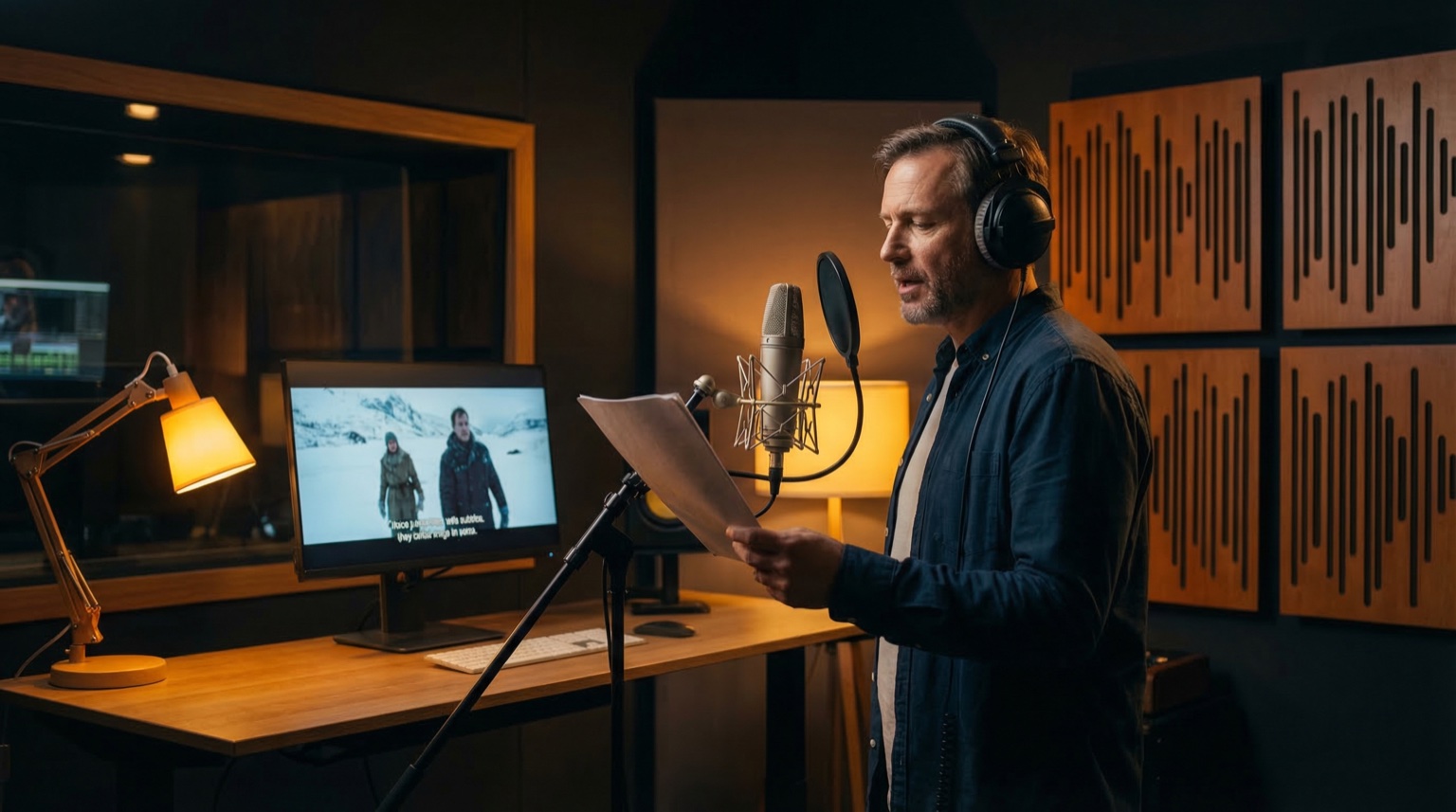
Sweden has traditionally been a subtitle country. But streaming platforms are changing the rules — and dubbing demand is growing every year. This is a breakdown of why it looks the way it does, what is changing, and how the dubbing process actually works.
Key points at a glance
- Sweden has never dubbed adult content at scale. Children's programming is the exception — and always has been.
- Netflix, Disney+, and other streaming platforms are driving dubbing demand upward, particularly for children's and family content.
- Dubbing (lipsync) and voice over (off-screen narration) are two entirely different processes with different requirements, costs, and use cases.
- The process involves script adaptation, casting, synchronisation, and mixing. Each step affects the final result.
- Quality variation is significant. Cheap dubbing is immediately audible — and damages the brand it was meant to support.
Why Sweden never dubbed
The answer is economics and culture.
Sweden has ten million inhabitants. Germany has eighty. France has seventy. In dubbing countries — Germany, France, Italy, Spain — the large domestic audience absorbs the cost of dubbing all foreign content. In Sweden, Norway, and Denmark, the market has never been large enough to justify that cost for adult content.
The result was a subtitle culture. Swedes grew up reading along. It produced a population with unusually strong English skills as a side effect — but the root cause was economic, not educational.
There is also a cultural attitude at play. Many Swedes consider dubbing adult content to be reductive — the original actor's voice is part of their performance, and replacing it removes something essential. This argument has merit for English-language content, which most Swedes understand. But it breaks down for Korean, Turkish, or Portuguese content — which now makes up a significant share of streaming catalogues. For those languages, dubbing offers a different kind of accessibility that subtitles alone cannot match.
Children's programming has always been dubbed. Children who cannot read need dubbing. SVT (Swedish public television), TV4, and later Nickelodeon and Cartoon Network have dubbed children's content into Swedish for decades. It is an established part of the Swedish media industry. Swedish children's dubbing has also produced iconic voice performances — the Swedish voices behind Disney classics defined those characters for generations of Swedish children.
Adult content? Subtitles. Always. Until the streaming platforms arrived.
The streaming effect
Netflix launched in Sweden in 2012. Disney+ came in 2020. Amazon Prime Video, HBO Max (now Max), Apple TV+ — all have established themselves in the Swedish market.
What changed the dubbing landscape was not that the platforms wanted to dub. It was that they needed to for their global strategy.
Netflix produces content for 190 countries. Their internal standard requires dubbing in at least 20–30 languages for major titles. Swedish is one of them. That means series and films that would never have been dubbed into Swedish under the old system now dub as standard.
The effect is most visible in three areas:
Children and family. This is where demand is strongest and most obvious. Animated originals from Netflix, Disney+, and Apple TV+ dub into Swedish. Volume has increased significantly since 2020.
Anime. A niche that has grown enormously. Anime fans in Sweden have historically watched with Japanese original audio and English subtitles. Now Crunchyroll and Netflix dub anime into Swedish — primarily for a younger audience.
Reality and documentary. Not classical dubbing, but voice over localisation. Off-screen narration that replaces the original's narration track. It is technically simpler and cheaper than lipsync, but still requires professional production.
Beyond these three areas, a fourth trend is emerging: corporate content localisation. International companies that previously only subtitled their internal training videos and onboarding content are discovering that dubbing delivers better learning outcomes. A sales training video in Swedish with a voice that sounds like a colleague performs better than a subtitled English version. It is not broadcast dubbing, but it uses the same fundamental process.
Dubbing versus voice over: two different processes
The terms are frequently confused. The distinction matters.
Dubbing (lipsync) means a voice actor replaces the original voice synchronised with the lip movements on screen. It requires:
- Script adaptation (not just translation — the text must fit the mouth movements).
- Time codes for every line.
- Recording in sync with picture, often in short segments.
- Mixing where the new voice integrates with the original audio mix.
It is expensive, time-consuming, and requires specialist expertise at every stage.
Voice over (off-screen) means a narrator voice is layered over the original audio, often with the original voice lowered in the background. It is used for:
- Documentaries and reportage.
- Reality TV.
- Corporate films localised for other markets.
- Training and e-learning material.
It is simpler and cheaper. You do not need lipsync, just a good voice that matches the pace and tone. But it still requires professional recording and broadcast quality standards.
A third variant is UN-style voice over — the narrator voice is layered over the original voice, which remains faintly audible in the background. It is commonly used in news segments and international reportage. It is functional but never invisible — the listener always knows it is a translation.
The process step by step
Whether you are dealing with dubbing or voice over localisation, the process follows the same basic structure.
1. Script adaptation
This is not translation. It is adaptation. A translator can give you the right meaning. A script adapter gives you the right meaning that fits in the mouth, in the time, and in the culture.
For dubbing, every line must:
- Match lip movements (bilabials like "p," "b," "m" must sync).
- Fit within the same time frame as the original.
- Sound natural in Swedish — not translated.
The last point is where much dubbing fails. Swedish dubbing that sounds like translated English loses the viewer immediately. The adapted script needs to feel like something a Swedish person would actually say.
A skilled script adapter also handles cultural references. An American sitcom that references Thanksgiving does not need a footnote — but the line needs to work even if the viewer has no context. Humour is particularly difficult. Wordplay, slang, and rhythm-based jokes often need to be rewritten entirely rather than translated. This is creative work, not mechanical work, and it is where the quality gap between experienced and inexperienced adapters becomes obvious.
2. Casting
The voice choice determines whether the dub works. A character who sounds like a 45-year-old man in the original needs a 45-year-old man in Swedish — not a 25-year-old trying to sound older.
In Sweden, the casting pool for dubbing is considerably smaller than in traditional dubbing countries. Germany has thousands of established dubbing actors. Sweden has hundreds, perhaps. That means casting requires more work, and the same voices may appear across multiple productions.
This has also created an informal hierarchy. Certain Swedish voice actors have become the de facto voice for specific foreign actors, similar to Germany where every Hollywood star has "their" German voice. In Sweden it is less formalised, but the pattern exists — particularly in animated film where continuity between sequels matters to the audience.
3. Recording and synchronisation
Dubbing recording is done in short loops — segments of 5–15 seconds that play on screen while the voice actor delivers the line in sync. It requires:
- A director managing timing and tone.
- An engineer handling the recording.
- Reference video with time codes.
- Often multiple takes per loop.
It is slow. A 22-minute animated episode can take 4–6 hours to dub with an experienced actor. With an inexperienced one, it takes longer.
The process resembles ADR (Automated Dialogue Replacement) in film production, but with an additional layer of difficulty: you are not just matching timing, you are matching another person's performance in another language. The actor must absorb the original's emotion and energy and deliver it through their own interpretation — in real time, in sync, loop after loop. That is why dubbing actors with theatre training tend to perform better. They are trained to inhabit a character quickly and sustain consistency across takes.
Voice over localisation is faster. The narrator reads the script without syncing to lips. The pace is guided by the original, but the margin is larger. A 45-minute documentary can be recorded in 2–3 hours.
4. Mixing
The dubbed voice must integrate with the original mix — music, sound effects, atmospheres. The original voice is removed (or lowered for UN-style) and the new voice is placed with correct level, EQ, and room ambience.
Poor mixing destroys good dubbing. If the voice sounds like it comes from a different room than the picture, the illusion breaks. This step requires a sound engineer who understands dubbing-specific mixing.
One detail that is often overlooked: the international mix (M&E — Music and Effects) delivered for dubbing varies in quality. Sometimes sound effects that were embedded in the original dialogue track are missing — footsteps, clothing movement, breathing. A competent dubbing mixer identifies these gaps and fills them, either with foley or library sounds. Otherwise, scenes suddenly sound empty apart from voice and music.
Cost and quality variation
Dubbing costs real money. A feature film dubbed into Swedish can cost 20,000–50,000 euros depending on number of characters, studio costs, and script adaptation. An animated series costs 5,000–15,000 euros per episode.
Voice over localisation is cheaper. A documentary episode with narration can cost 1,500–4,000 euros depending on length and rights.
The quality variation is enormous. The major platforms (Netflix, Disney+) have quality standards that require experienced dubbing directors, approved studios, and QA processes. But the market also contains quickly and cheaply produced dubbing for smaller platforms, YouTube content, and corporate productions.
The difference is audible. Cheap dubbing has:
- Poor lipsync (words do not match the mouth).
- Stiff delivery (the actor is reading rather than acting).
- Inconsistent audio quality between characters.
- Translated Swedish that sounds like English with Swedish words.
Professional dubbing sounds transparent. You forget you are listening to a dubbed version. That requires investment at every step of the chain.
What drives the price differences? Primarily three things. First: number of characters. A film with four speaking roles costs significantly less than one with twenty. Each character requires casting, separate studio time, and often a separate recording session. Second: script adaptation complexity. An action film with short lines is simpler to adapt than a dialogue-driven drama where every sentence carries nuance. Third: time pressure. Streaming platforms often have tight deadlines — a new season must launch globally on the same day. Rush delivery costs more, both in overtime and in the quality risk that comes with speed.
What this means if you are localising into Swedish
If you are commissioning voice over localisation for the Swedish market — whether dubbing, off-screen narration, or documentary — there are practical considerations.
Script adaptation is as important as the voice. A good voice with a bad script sounds bad. Invest in a script adapter who knows Swedish idiom and culture, not just a translator.
Casting takes time. The Swedish dubbing market is small. Good voices are booked. Plan casting in advance.
Rights are different. Dubbing rights are often more complex than standard voice over. They can involve copyright on the script adaptation, artist compensation per broadcast period, and territorial licences. Voice over rights, licences and channels provides an introduction.
Technical requirements. Dubbing requires specific delivery formats — often Pro Tools sessions with stems, not just a WAV file. Clarify format requirements before recording begins.
What you should do
- Determine whether you need dubbing (lipsync) or voice over (off-screen). This drives budget, timeline, and process.
- Hire a script adapter, not just a translator. The difference is audible.
- Cast early. The Swedish market has limited capacity.
- Specify delivery format and technical requirements before recording begins.
- Plan for QA. Listen through the entire delivery against picture before mixing is finalised.
- Budget realistically. Cheap dubbing costs more in the long run — in re-takes, poor reception, and brand damage.
Next steps
The Swedish dubbing market is growing. Streaming platforms have created demand that did not exist ten years ago. That means more opportunities — and more pitfalls for those who do not know what to require.
If you are planning a localisation into Swedish and want a walkthrough of what is needed, contact me. For voice over localisation outside dubbing — corporate video, e-learning, documentary — you can hear examples in the demos and read about rates.
FAQ
Why does Sweden not dub all content like Germany does?
Economics. Sweden has ten million inhabitants. Germany has eighty. The German market absorbs the cost of dubbing everything. The Swedish market does not — except for children's content, which has always been dubbed.
Is dubbing into Swedish increasing?
Yes. Streaming platforms' global strategy requires dubbing into Swedish as standard for major titles. Volume has increased markedly since 2018, particularly in children's and family content.
What is the difference between dubbing and voice over?
Dubbing (lipsync) replaces the original voice synchronised with lip movements. Voice over layers a narrator voice over the original audio, often with the original voice lowered in the background. Dubbing is more expensive and time-consuming.
How long does it take to dub a film into Swedish?
A feature film typically takes 3–6 weeks including script adaptation, casting, recording, and mixing. The timeline depends on number of characters and studio bookings.
Can a voice over artist do dubbing?
Not necessarily. Dubbing requires acting ability and timing that differ from standard voice over. Most dubbing artists have theatre training or specific dubbing experience. Voice over artists without dubbing experience can deliver off-screen narration but not lipsync.
How much does dubbing into Swedish cost?
It varies significantly. An animated episode (22 minutes) costs 5,000–15,000 euros. A feature film costs 20,000–50,000 euros. Voice over localisation of a documentary costs 1,500–4,000 euros per episode.
How do I ensure good quality in Swedish dubbing?
Hire an experienced dubbing director, a script adapter (not just a translator), and a studio with dubbing experience. Plan a QA listen-through against picture before delivery. And budget adequately — quality dubbing requires time at every step.
Will subtitles disappear in Sweden?
No. Subtitles will remain the standard for adult content. But dubbing is growing as a complement, particularly in children's and family content and for accessibility. The trend is that more titles offer both subtitles and dubbing as options.
Read more: