
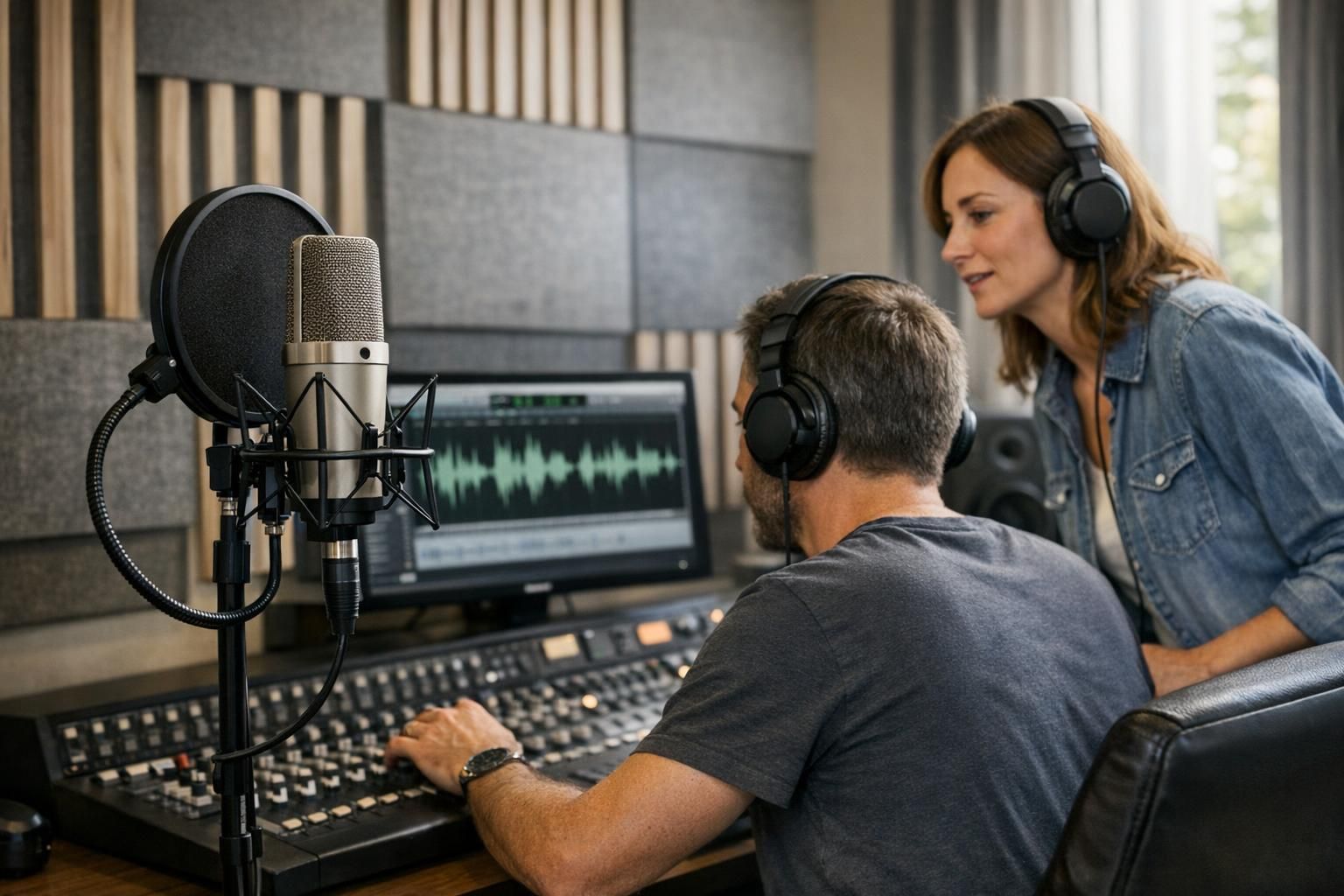
Broadcast quality voice over means that the voice recording maintains a technical and sonic level that is suitable for broadcast: clean signal, controlled dynamics, correct level, low noise, and consistent sound between takes.
The key points at a glance
- It's less about an “expensive mic” and more about noise control, room, levels, and consistent delivery.
- Quality assurance is a process: specification → test → recording → verification → delivery.
- If you want to avoid the end client questioning the audio: lock in requirements and references before the recording day.
What “broadcast quality” usually means when you receive the files
For an agency, “broadcast quality” is often a label. For a producer, it is a list of requirements. In practice, broadcast quality voice over is a delivery that can be laid over video without needing to salvage it with noise reduction, harsh EQ, or retakes due to audio differences.
What you typically should be able to expect:
- Clean and stable level: a clear signal without clipping and not too low.
- Controlled room: no obvious echo, no “boxy” reflections, no room change between takes.
- Low noise level: no constant hum, no obvious computer fan noise, no electrical interference.
- Consistency over time: the same tone and level throughout the entire script, even if recording is done in multiple takes.
- Delivery that matches your technical requirements: format, sample rate, bit depth, mono/stereo, file naming, separation per spot/variant.
A common misconception is to treat broadcast quality as an after-processing issue. It isn't. If the room is wrong or if the noise is too high, it's rarely helpful to “fix it in the mix” without the voice losing naturalness.
Common reasons why the end client does not approve the sound
What typically causes issues is not that the voice is “bad”, but that it doesn't sound like the rest of the production or like the client's reference.
- The room is audible. The end client often describes it as “home-recorded” or “a bit of echo.”
- Too aggressive noise reduction. Results in a watery/phasey sound, especially in pauses.
- Incorrect proximity/coloration. The mic is too close (too much proximity) or too far (thinner, more room).
- Inconsistent takes. Different distances, different levels, different compression on different lines.
- Wrong delivery format. You need 48 kHz/24-bit mono WAV, you are given 44.1 kHz or MP3.
These are the causes of those late rounds: “Can we just get it a little cleaner?” or “It doesn’t feel like broadcast.” Those rounds can be avoided if the requirements are concrete and checked before you lock the version.
How to assess broadcast quality without being a sound engineer
You don’t need to sit with measurements to make an initial qualification. Do three quick listens:
- Listen to the pauses. Is there silence between the words, or do you hear hum/room noise?
- Listen to S and F. Is it natural, or is there a noticeable de-esser that drags down the entire treble?
- Listen at three different places in the script. Do they sound like the same take? If the timbre changes, it is often due to different mic positions or different room/settings.
Then you do a practical check: place the voice in your timeline together with music and SFX (even if they are preliminary). If you immediately start compensating with aggressive EQ or a gate to make it sit, the delivery is likely not at broadcast level for your use case.
Process / checklist
- Lock in the specification before recording: WAV/48 kHz/24-bit (or your requirements), mono, file structure, naming standard, delivery per version and whether you want 'raw' and/or lightly processed.
- Send a reference: a link to a previous film/spot or audio reference that the client likes. “Broadcast” without a reference becomes interpretation.
- Request a short test: 10–15 seconds from the script, in the same chain as the final delivery. Approve tone and level before the entire pass is recorded.
- Check room and noise: listen in headphones at the pauses. If the noise is obvious now, it will be obvious later, especially in quieter sections.
- Check dynamics: no clipping, no flat peaks, no “pumping” from too hard compression.
- Check consistency: sample three spots in the file and compare. If they sound different: stop and ask for a retake with the same mic position/setting.
- Delivery check: sample rate/bit depth, mono/stereo, length per file, correct head/tail, no unnecessary effects or limiters that ruin transients.
- Archive: save the approved test file as a future reference for the next production with the same client.
Next steps
If you’re going to quality-check a delivery: start by defining your specification and a reference that matches the client’s expectations. Then request a short test clip before full recording. It’s the easiest path to “approved directly” without late audio discussions.
Broadcast quality is especially important for commercials -- read more about commercial voice over and what applies to format, rights and delivery.
If you want to quickly align the requirements, you can read more about how I work or send your specification and a reference via contact.
FAQ
Do I need to request “raw” or processed voice over for broadcast quality?
Ask for lightly processed (high-pass and mild compression) if you want to be able to drop it in directly. Ask for raw if you have a clear post-chain and want to match against the rest of the audio. The most important is that you get a test clip in the same chain as the final file.
What is a reasonable technical delivery for video (agency/production)?
Often: mono WAV, 48 kHz, 24-bit. Plus clear file names per version. If you get something else: request an export re-export, it’s faster than living with it.
How do I avoid the client saying it doesn't sound professional even though the voice is good?
Lock in reference and requirements before recording and approve a test clip. Most objections relate to room/tonal quality and are easiest to capture before the entire script is recorded.
Can you salvage a voice over that is not broadcast quality in post?
Sometimes, but often with audible side effects (watery sound, reduced presence). If the room and the noise are off, re-recording is almost always faster and yields better results.
Read more: