
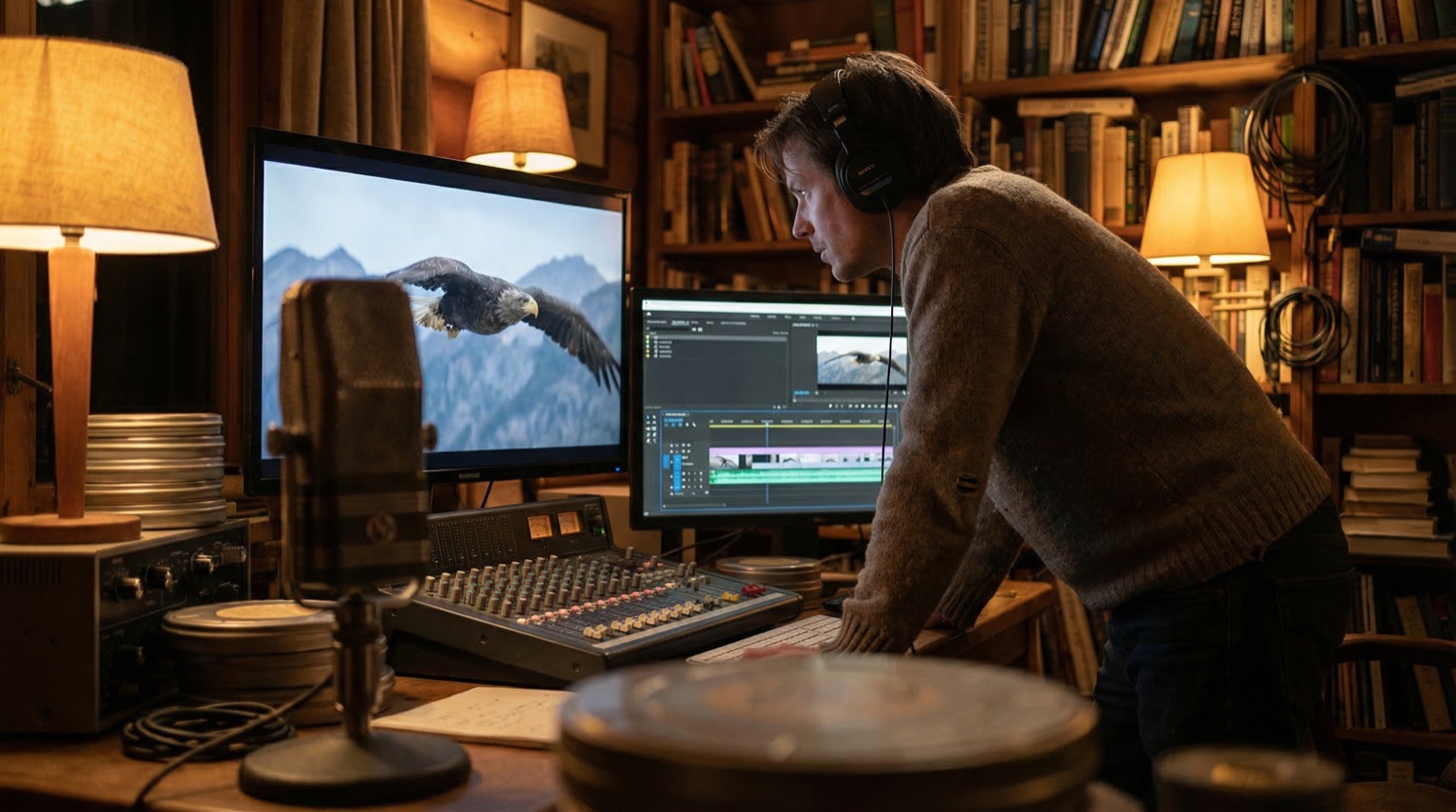
A documentary narrator who tries to sound dramatic ruins the film. One who sounds like they know what they're talking about — elevates it. That's the entire difference, and it separates documentary voice over from nearly everything else I do.
Key points at a glance
- Documentary voice over requires authority without drama. The voice carries facts, it doesn't sell them.
- Tone is set by the subject, not the voice over artist. Nature film, social documentary, and historical documentary demand entirely different registers.
- Documentary pacing is slower than corporate narration — the viewer needs time to process picture and voice simultaneously.
- Breathing room and pauses matter as much as words. Silence is where the picture does its work.
- The director steers the tone. A good director gives specific guidance. A bad director says "do what feels right."
- Technically: documentary mixes have a narrower dynamic window. The voice must work against music, atmosphere and interview clips without dominating.
- Military production work is a good example: matter-of-fact voice that respects the subject without adding drama.
What separates documentary from corporate narration
Corporate video has a purpose: get the viewer to do something. Buy, book, sign up, understand a process. The voice drives a message forward. You know where you're going.
Documentary has a different contract with the viewer. You're showing a reality. You present facts, stories, perspectives. The voice provides context — it doesn't steer the emotion. That sounds like a small distinction. In the booth, it's a completely different recording.
In corporate video, I can often read the script straight through with a clear direction from the first word. The pacing is predictable. The tone is consistent. In documentary, the tone sometimes changes mid-sentence — because the subject changes. One section covers geology. The next covers a family that lost their home. The voice has to follow that without becoming theatrical.
The most common mistake I hear in documentary productions is voices that "play documentary." They drop their register, add gravitas, insert pauses where none are needed. It sounds like a parody of David Attenborough. The problem isn't that they lack vocal capability. The problem is they're trying to impress rather than inform.
A good documentary voice is transparent. You shouldn't think about the voice. You should think about what the voice is telling you.
There's another difference that rarely gets mentioned: corporate video almost always has a finished script at recording time. Documentary scripts change. Sometimes during the session. Sometimes after the edit has been restructured. I've recorded documentaries where the final script arrived two weeks after the first recording day, because the director had re-cut the film and needed a different sequence. That requires flexibility — and it requires the producer to budget for it.
Genre registers: nature film, social documentary, history
Documentary isn't a genre. It's an umbrella. And under that umbrella, the tonal range is so wide that talking about "a documentary voice" as a single thing is meaningless.
Nature and science. A calm, descriptive tone works here. Pacing follows the picture. When the camera pans across a landscape, the voice has time. When a predator strikes, the tempo can increase — but never so much that it feels like sports commentary. You describe, you don't react. I've done this type of work where the director said: "Imagine you're explaining this to a friend who's genuinely interested but not in a hurry." That's a solid guideline.
Social documentary. This is the hardest type. You're narrating people's lives, sometimes trauma, sometimes injustice. The voice must never take over from the people being interviewed. You provide context, not commentary. Pacing is often even slower, with longer pauses. The viewer needs time to process what's said — and what isn't said.
The biggest trap here is empathy overflow in the voice. If the script covers children in a conflict zone and the voice sounds like it's about to cry — the voice has occupied the film's emotional space. The images and interviews carry the emotion. The voice stays steady.
Historical documentary. This is about giving facts credibility. Dates, names, places, cause and effect. The tone is matter-of-fact, the pacing even, and you need to be extremely careful with pronunciation of historical names and terms. Mispronunciation in this genre destroys credibility instantly.
Investigative documentary. Close to journalism. The tone is neutral but engaged. You can't reveal where you stand. You present facts and let the viewer draw conclusions. This requires a very controlled voice — no emphasis that suggests what the listener should think.
The point is that you can't prepare for "documentary" as if it were one style. You prepare for the specific project. I always ask: what type of documentary is this? Who's the audience? What should the viewer feel — and equally important: what should the viewer not feel? Those questions determine everything from register to speaking tempo.
Authority without drama: lessons from military production
I've done voice over for the Swedish Armed Forces, including material about their Winter Unit. It's a good example of what documentary tone means in practice.
The subject matter is inherently dramatic. Soldiers operating in extreme conditions, minus 30, heavy packs, in terrain that's trying to kill them. It would be easy to apply a dark, dramatic voice. That would have been exactly wrong.
Military communication works because it's matter-of-fact. They don't need to sell drama — reality is enough. The voice I delivered was straight, clear, with a tempo that gave the pictures room. No artificially deep register. No unnecessary gravitas. Just information presented with respect for the subject.
What worked was that I treated the material as fact, not as story. I read it as if I were explaining something important to someone who needed to understand — not someone who needed to be impressed.
That's a principle I carry into every documentary job: treat the subject with respect. Let it be what it is. Don't add emotion that isn't in the script.
There's a paradox in this. The more dramatic the subject, the calmer the voice needs to be. The military material could have been turned into an action trailer with the right voice and the right music. But it wouldn't have been credible. Credibility comes from treating the subject as it is — not as you want it to feel.
I've turned down documentary work where the director wanted an "epic narrator voice" for material about real people's experiences. That's not what I do. If you want a Morgan Freeman delivery for your documentary about climate change impacts on Arctic communities — someone will do it. But it won't be credible. It'll be entertainment.
The director's role: why guidance determines everything
In commercial work, I often get a brief and record on my own. In documentary, I want a director. Not because I can't make decisions — but because documentary has nuances that only someone who knows the material can steer.
A good director gives specific guidance:
- "This section is fact-based. Straight tone, no pauses beyond breathing."
- "Pull back here. The interview that follows carries the emotion. Your role is to set the scene."
- "This is a turning point in the film. Slow down. Give each sentence its own breathing room."
A bad director says: "Do what feels right." That's not direction. That's an invitation to guess.
The best documentary work I've done has been with directors who know exactly what they want. Not because they're controlling — but because they've lived with the material for months or years and know where every word should land. My job is to deliver what they hear in their head.
If you're producing a documentary and hiring a voice over artist: sit in on the session. Or join remotely via Source-Connect or Cleanfeed. You'll need to adjust the tone in real time. Sending a script and hoping for the best rarely produces good documentary results.
One more thing about direction: give me context. If I'm reading a paragraph about a village that was evacuated — tell me. Show me the footage if it exists. I don't need to see the entire film, but I need to know what's happening around the voice. A sentence that closes a sequence of survivor interviews requires a different energy than the same sentence after a map graphic. Context steers everything.
The worst documentary recordings I've done — the ones that took the most re-takes — were when I received the script without context. "Read pages 3 to 7." No visual reference. No film structure. No guidance about what came before or after. That approach works for e-learning where each module stands on its own. It doesn't work for documentary.
Technical considerations: breathing room, levels and mixing
Documentary voice over has different technical requirements than corporate narration or commercials.
Breathing room. In commercial work, breaths are removed or compressed. In documentary, breaths often need to stay. They create rhythm. They signal that what comes next is new. I record with deliberate breathing pauses between paragraphs — not because I need the air, but because the mixer needs space to place atmosphere or music under the transition.
Dynamics. Documentary mixes typically have a narrower dynamic window than commercials. The voice sits against music, atmosphere, interview clips and sometimes archive audio. If the dynamic range in my recording is too wide, it becomes difficult to mix. I deliver with more even dynamics than I would for pure narration, but without compressing away all nuance. It's a balancing act.
Microphone technique. I use an Austrian Audio OC18 for most documentary work. It gives a clean, detailed signal without colouring too much. Documentary voice shouldn't sound "big" or "polished" — it should sound present. Distance to the microphone is typically slightly greater than for commercials. That gives a more neutral, less intimate character.
Delivery. Documentary is usually delivered as one long file per section or chapter, not individual lines. The director and editor need to work with the flow. I label files clearly and deliver in WAV 48 kHz/24-bit unless specified otherwise. If the script has timecodes — and it should — I follow them.
Pacing. Documentary text is typically read 10–20% slower than corporate text. Not because it needs to be "atmospheric." Because the viewer is processing picture and voice in parallel, and if the voice pushes tempo, the picture loses its effect. That's one of the things that separates an experienced documentary voice from someone who just "reads slowly."
Room and acoustics. Documentary voice is more sensitive to room tone than commercial voice over. Commercials are compressed and processed heavily in the mix — the room disappears. Documentary often has a more open mix where the voice gets more space. The room becomes audible. I record in an Isovox 2 Midnight booth, which gives a dry, controlled signal. That gives the mixer maximum latitude to place the voice in the film's sound design. If you record documentary voice in a standard office with hard surfaces — it shows. And it looks amateur in an otherwise professional production.
Sync to picture. In corporate video and commercials, timing is locked — 30 seconds is 30 seconds. In documentary, the tempo is more organic, but you still need to hit specific picture changes. I always ask for timecodes or a rough cut to play against. It's not about hitting exact frames — it's about knowing where the subject shifts so the voice lands correctly against the picture.
What you should do
If you're producing a documentary and need voice over
- Send the full script, not excerpts. I need to understand the arc and tone of the entire film, not just my section.
- Describe the genre. Nature, social, historical, investigative — this determines the foundational tone.
- Provide tone references. Send another documentary that has the right tone. "Like this one, but slightly calmer" is better direction than "warm but authoritative."
- Plan a directed session. Documentary benefits from collaborative direction. Be present during recording.
- Mark pronunciations. Geographic names, personal names, scientific terms — anything that could be mispronounced should have a phonetic guide in the script.
- Allow time in the schedule. Documentary recording takes longer per finished minute than corporate. Plan for it.
If you're writing a documentary script for voice over
- Write for the ear. Read aloud. If you can't say the sentence in one breath without sounding rushed — split it.
- One thought per sentence. Documentary scripts aren't essays. Short sentences give the voice room.
- Mark pauses. Use
[pause]or//where you want the voice to give the picture space. - Avoid descriptive narration. Don't write "as we can see in the image" — the viewer sees the image.
- Stay factual. If the facts are dramatic enough — trust them.
Next steps
Documentary voice over is about serving the material. Not about showcasing the voice. The best documentary narration is the one you don't notice — the one that makes you understand more, see more clearly, and stay in the film.
If you're producing a documentary and want to discuss tone and direction, contact me and we'll have a brief call. Fifteen minutes is usually enough to land the tone. You can hear examples in my demos.
For more on writing scripts that actually work in the studio: read how to write a voice over script that works. And for a broader view of delivery standards: broadcast quality voice over: requirements and delivery.
FAQ
What separates documentary voice over from corporate narration?
Corporate video drives a message. Documentary provides context. In practice, that means documentary voice over has more varied pacing, more pauses, and a tone that adapts to the subject rather than to a brand. The voice should be transparent, not persuasive.
Should I be present during the recording session?
Yes, if possible. Documentary has nuances that are difficult to capture in a brief. Joining remotely via Source-Connect or Cleanfeed lets you adjust tone in real time. It saves time and re-takes.
How slow should documentary narration be?
Typically 10–20% slower than corporate text. Exact pacing depends on the picture. Slow pans tolerate more air. Fast-cut sequences need the voice to keep up without pushing. The director should steer pacing during the session.
Can the same voice work for nature film and social documentary?
Yes, but it requires conscious adaptation. Nature film tolerates a descriptive, somewhat warmer tone. Social documentary demands more restraint. It's not the same recording, even if it's the same voice.
What if the script is too dense to read naturally?
Shorten the sentences. Remove subordinate clauses. Read aloud and mark places where you run out of breath. A script that can't be read without stress can't be recorded without stress. See how to write a voice over script that works for specific techniques.
What equipment is used for documentary recording?
I use an Austrian Audio OC18 in an Isovox 2 Midnight booth, recording in Reaper with a RodeCaster Pro. For documentary, I want a clean, neutral signal without excessive proximity effect. The microphone is chosen for the genre — not for "the most expensive option."
How is documentary voice over delivered?
Usually as WAV 48 kHz/24-bit, one file per section or chapter. Clear file names that match the script structure. If there are timecodes, I follow them. Delivery via Source-Connect, Cleanfeed, or file transfer depending on the production's workflow.
Does documentary voice over cost more than standard narration?
Documentary recording typically takes more time per finished minute. The pace is slower, more takes are needed for nuance, and directed sessions require more time. Pricing depends on scope and usage. See rates for an overview.
Read more: