
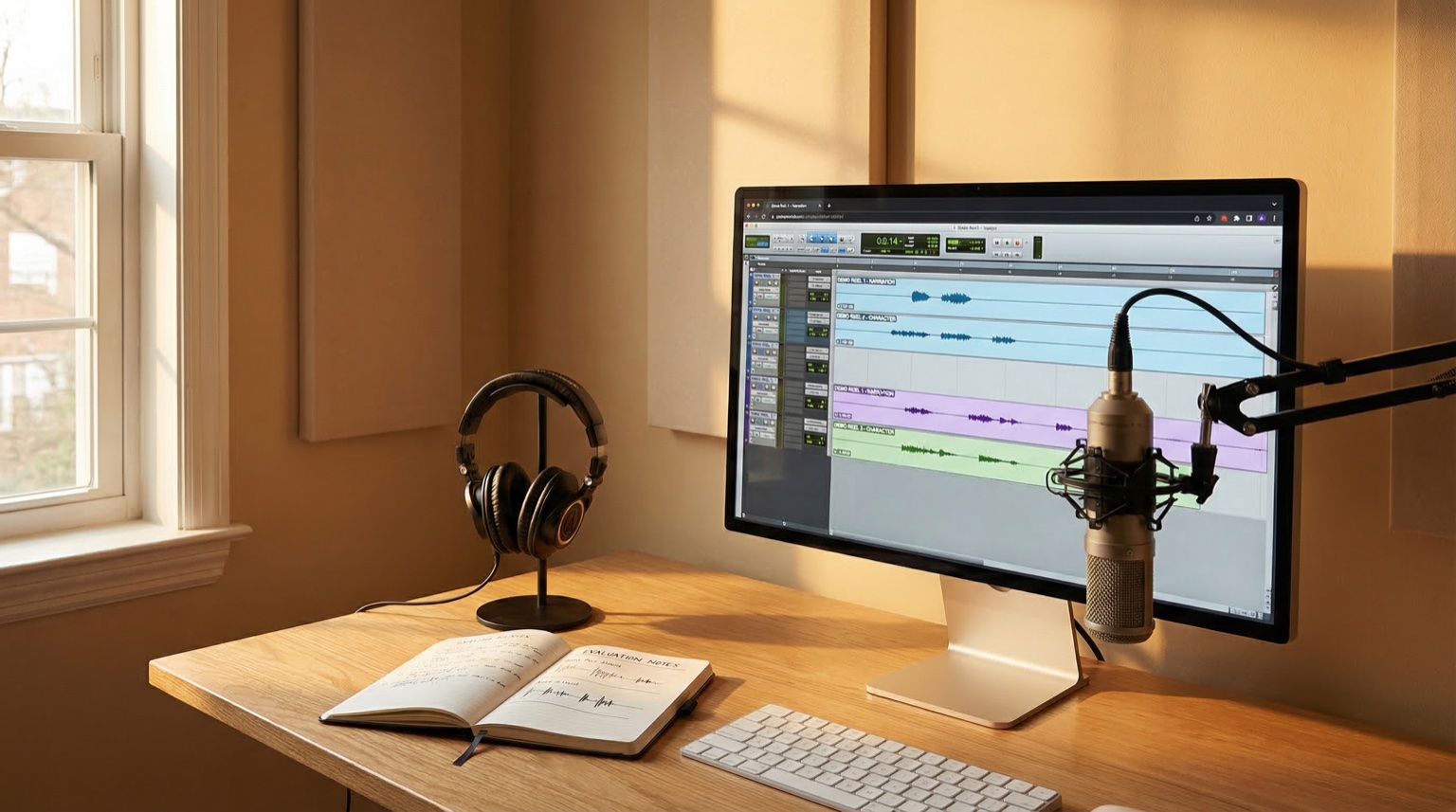
A demo shows you what the voice sounds like. It does not show you whether the person delivers on deadline, takes direction, or understands your brand. Choosing a voice over artist based solely on a demo reel is like hiring a project manager based on their headshot.
Key points at a glance
- A demo is a highlight reel. It tells you little about how the person handles your specific script under time pressure.
- Five questions before booking reveal more than twenty demos: turnaround time, revision policy, studio quality, rights, and experience with your type of project.
- Rosters (agencies) give you breadth but add cost and communication distance. Direct contact gives faster feedback loops and often better pricing.
- "Cheapest" is rarely cheapest. Re-takes, quality issues, and delays cost more than the price difference.
- You can assess studio quality from a delivered file without being an audio engineer. You just need to know what to listen for.
What a demo actually tells you — and what it does not
A good demo shows three things: the voice's fundamental character, its range, and that the person can read copy. That is all.
I have been recording demos since the mid-1990s. Every demo I have produced was carefully selected, edited, and mixed under ideal conditions. It represents my best work with no time pressure. The same is true for every voice over artist. Nobody puts their worst take in the reel.
What the demo does not show:
- Direction tolerance. Can the person take a change mid-session without losing energy or getting frustrated? You will not hear that in a demo.
- Delivery reliability. Will the file arrive at 3 PM as promised, or at 10 PM with an apology? You will not hear that either.
- Script comprehension. Does the person understand the difference between an internal training script and an advertising spot? A demo shows that the voice exists. It does not show that the mind behind the voice grasps context.
- Everyday technical quality. The demo may have been recorded in a professional studio the person rented for the occasion. Your deliveries might come from a home office with a computer compressor and street noise outside.
I have had clients who chose a different voice based on the demo, ran into delivery problems, and came back. Not because my voice was necessarily better — but because the full package worked.
Five questions to ask before booking
Before you commit, ask these questions. You do not need to be confrontational. Just be clear.
1. What turnaround can you guarantee?
Do not ask "how fast can you deliver?" — that produces an optimistic answer. Ask instead: "If I send the script Tuesday morning, can you deliver by Wednesday before noon?" That gives you a concrete commitment you can hold the person to.
An experienced voice over artist knows how long it takes to record a certain word count and add time for editing, export, and review. If the answer is vague — "I'll do my best" — that is a warning sign.
A practical benchmark: an 800-word corporate narration script takes roughly 45 minutes to record, plus an hour for editing and file preparation. A seasoned artist can give you that estimate immediately. If the person cannot answer how long 800 words takes, they either lack the experience or the routine — and both are problems when your production schedule depends on them.
2. How do you handle revisions?
There is no industry standard. Some artists include one revision in the price. Others charge from the first change. Both models work, but you need to know which applies before you approve the quote.
Also ask: what happens if the revision is because I changed the script after recording? That is a different situation from the artist missing the tone or stressing the wrong word.
Here is what happens in practice: the client approves the script, the recording is done, and then someone internally wants to change two sentences. That is entirely normal — but it is new work. A professional artist has a clear policy for this. If the policy does not exist before you book, you end up negotiating mid-production. That slows everything down.
3. Where do you record, and with what equipment?
This is not gear snobbery. It is basic quality assurance. A voice over artist working from a treated room with a condenser microphone and a proper signal chain delivers differently from someone sitting with a USB headset at the kitchen table.
You do not need to understand every component. But the answer should be specific. "I have an Austrian Audio OC18 in an Isovox, recording into Reaper" is an answer. "I have good equipment" is not.
4. Have you done this type of project before?
A voice that works in commercials does not necessarily work in e-learning. The pace, energy, and structure are entirely different. If you are ordering an IVR menu, you want to know the person has recorded menu structures before and understands the technical requirements.
Ask for an example in the same category as your project. Not a general demo clip — an actual job in the same format.
5. What is included in the price?
It sounds basic, but it is surprisingly often unclear. Does the price include rights for all channels? Is it limited to one year? Does it include raw files or just a final mix? What does an additional revision cost?
How voice over pricing works: rights and usage explains the pricing structure in detail. Read it before comparing quotes — otherwise you are comparing apples and oranges.
Roster or direct contact
A roster (voice over agency or talent pool) can be the right choice when you are searching among hundreds of voices for a large project, or when you need voices in languages you cannot evaluate yourself.
But there are trade-offs:
- Cost markup. The agency takes commission, typically 15–30 percent. That is built into the price you pay.
- Communication distance. You speak with a middleman who relays feedback. It works when everything is clear, but becomes cumbersome when nuance matters.
- Standardisation. Large agencies have processes designed to fit everyone. That sometimes means your specific need does not get enough attention.
- International casting. If you need voice over in multiple languages — say English, Swedish, and German for a pan-European campaign — an agency can simplify the logistics. But be aware that you lose control over nuance. You can evaluate the English voice yourself, but how do you know the German artist is delivering the right tone? The solution is to request reference clients or involve a local contact who can quality-check the language and delivery.
Direct contact works better when:
- You know roughly what type of voice you want.
- The project requires dialogue and iteration, not just a clean read.
- You want to be able to call and say "can you make that line a bit less formal?" without going through three layers.
I work almost exclusively with clients directly. That means the person who answers the email is the same person standing in front of the microphone. No middleman, no delay. It works well for most projects, from IVR menus to corporate video.
Why "cheapest" is rarely cheapest
There is a clear price variation in the voice over industry. The range can be 300 to 3,000 euros for the same type of job, depending on artist, rights, and delivery requirements. The temptation is to pick the lowest number.
Here is what typically happens:
Re-takes. If the quality does not hold up, you need re-takes. Each re-take costs time — your time to listen, formulate feedback, and wait for a new delivery. An experienced artist at a reasonable price often delivers correctly on the first take. A cheap artist sometimes delivers three times before it sits right.
Technical problems. Noise, room echo, inconsistent levels, cuts mid-word. You cannot fix these in post without it costing you. A professional recording has consistent levels, clean audio, and correct file format. That saves time in the mix.
Rights complications. A lower quote may mean limited rights. If you want to use the recording in a new channel six months later and it was not included, you pay again. Or you end up in a negotiation.
Delays. Time is money, literally. If production stalls because the recording has not arrived, the cost in idle project management and delayed launch exceeds what you saved on the voice.
A worked example. You are producing an internal training series of ten modules. You receive two quotes: 400 euros per module from an unknown artist and 650 euros per module from an experienced one. The cheaper artist delivers with uneven audio quality on three of the ten modules. You spend two hours per module formulating feedback and waiting for re-takes. Six hours of extra project management multiplied by your internal hourly rate — plus a delayed launch. The 2,500-euro difference would have paid for itself before the second module was complete.
This does not mean expensive is always good. It means you should compare what you actually get, not just the number on the quote. Voice over pricing gives you the framework.
How to assess studio quality from a file
You do not need to be an audio engineer to hear quality differences. Here is what to listen for:
Noise floor. Play the file and listen to the silence between sentences. Do you hear a constant hiss, fan noise, or computer hum? You should not. A professional recording has a quiet floor.
Room reflections. Clap your hands in your kitchen. That echo? It should not exist in a voice over delivery. Listen for a "tail" on the words. If you can hear the voice bouncing off walls, the room is not treated.
Consistency. Listen to the level throughout the file. Does the volume jump up and down between sentences? That suggests the recording was made without proper compression or normalisation, or that microphone technique and distance varied.
Clicks and mouth noise. Lip and mouth sounds that were not edited out. In a short commercial spot, it may not matter. In a 20-minute e-learning module, it absolutely does.
File format. If you asked for WAV 48 kHz/24-bit and received an MP3 at 128 kbps, the artist either did not understand the requirement or does not have the capability to deliver it. Both are bad signs.
A practical test. Request a short test delivery — 30 seconds is enough — before committing to a large project. Listen on headphones, not laptop speakers. Play it back in silence. What you hear in the first few seconds of quiet before the voice begins reveals more about studio quality than anything else. If you hear a computer fan, refrigerator hum, or traffic noise, the recording environment does not meet professional standards.
For more on what separates professional delivery from amateur audio, read broadcast quality voice over: requirements and delivery.
What you should do
- Listen to the demo for voice character, not to assess delivery capability.
- Ask the five questions (turnaround, revisions, studio, experience, pricing) before committing.
- Request an example in the same category as your project.
- Compare quotes on equal terms: same rights, same delivery scope.
- Listen for noise, room echo, and consistency in delivered files.
- Consider direct contact if you want fast, unmediated communication.
- Write a clear brief so the artist understands what you need. Creating a clear voice over brief shows you how.
Next steps
A demo is the start, not the finish. The best working relationships I have — clients I have worked with for five, ten years — did not begin because they loved my demo. They began because communication worked, deliveries held, and quality was consistent.
Do your research. Ask the questions. Weigh the full picture, not just the voice.
To hear what it sounds like in practice: demos. To ask the questions directly: contact me.
FAQ
Is listening to a demo enough to choose a voice over artist?
No. A demo shows voice character and range, but not delivery reliability, direction tolerance, or everyday technical quality. Use the demo as a first filter, not as the decision.
How do I know if a voice over artist has a good studio?
Ask about equipment and recording environment. The answer should be specific: microphone, preamp, recording software, room treatment. Also listen to delivered files — noise, echo, and inconsistent levels reveal a substandard setup.
What is the difference between a roster and booking direct?
A roster (agency) gives you more voices to choose from but adds cost and communication distance. Direct contact gives faster feedback loops and often lower pricing, but requires you to have a reasonable idea of what you are looking for.
How many revisions should be included in a voice over booking?
It varies. A revision caused by a changed script is reasonable to charge extra for. A revision caused by the artist missing the tone should be included. Clarify this in the quote — not afterwards.
Can I request a test recording before committing?
Yes, but respect that it is work. Many professional artists will do a short test recording of 30–60 seconds at no cost. Longer tests should be compensated. It is a reasonable investment for both parties.
How do I compare prices from different voice over artists?
Check that the rights are equivalent, the delivery scope matches, and the revision policy is clear. A quote of 800 euros with unlimited rights may be cheaper than one at 500 euros with rights limited to one year and one channel.
Should I choose an artist with experience in my specific industry?
It helps. An artist who has done IVR menus before knows how menu structures work technically. One who has done e-learning knows the pacing requirements. You save time on direction and re-takes.
How important is it that the voice over artist understands my brand?
It is critical for longer collaborations. For a one-off job, a good brief is enough. But if you are planning ongoing production — campaigns, training material, IVR — you want an artist who understands the tone and can deliver it without detailed direction every time.
Read more: