
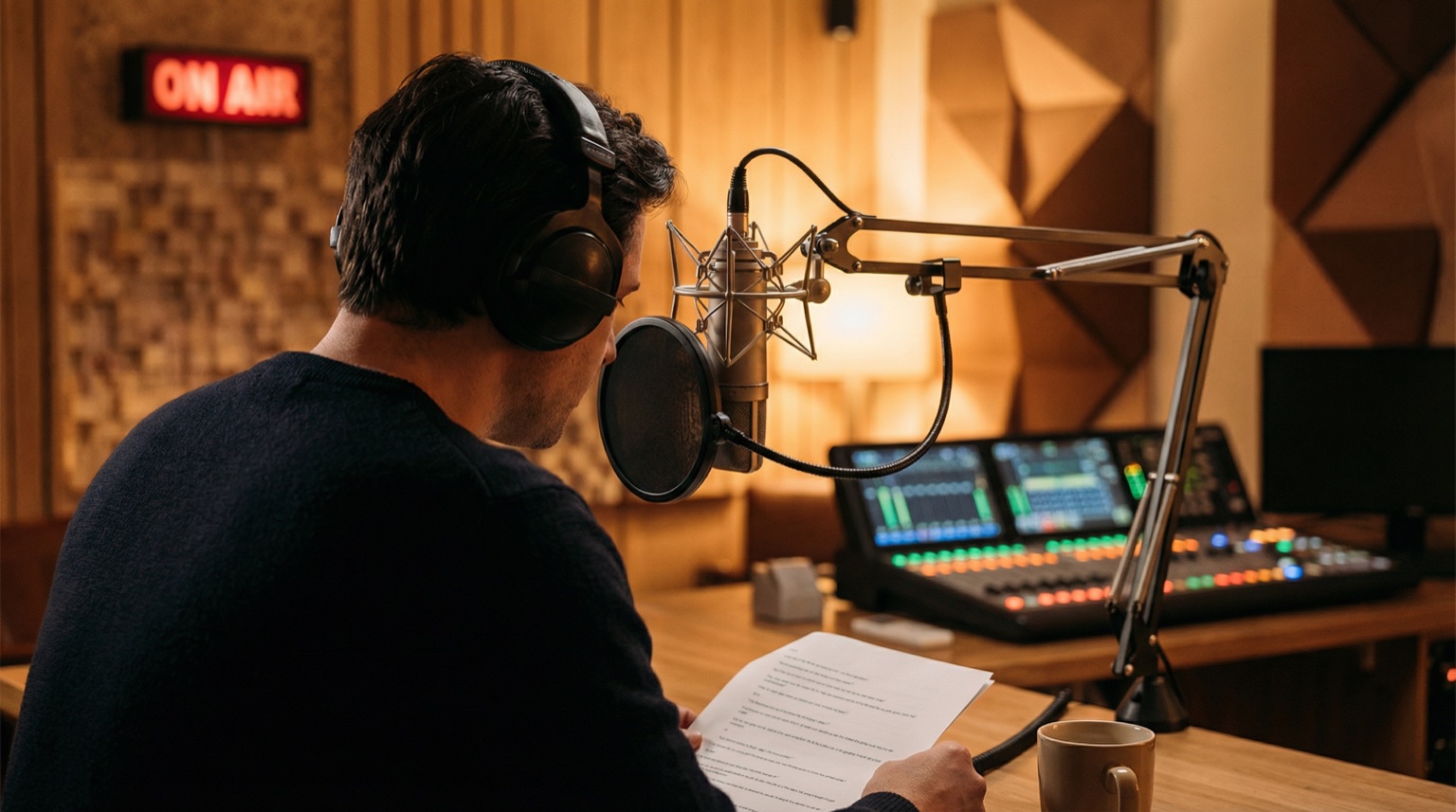
Radio voice-over is a specialized discipline that demands strict timing, technical accuracy, and understanding of broadcast standards. Unlike other media, radio spots leave no room for visual reference — the voice carries the entire message. Whether you're recording a 15-second commercial spot, a station jingle, or a live promotional read, radio work requires precision that separates professionals from amateurs.
What it is
Radio voice-over encompasses all spoken content delivered for broadcast on traditional radio (AM/FM/DAB) and streaming radio platforms. This includes commercial spots, station imaging, promos, jingles with voice, pre-produced shows, and live reads during news or talk programming.
Radio is not a single format. The industry has evolved from AM-only transmission to include FM, Digital Audio Broadcasting (DAB/DAB+), and streaming services like podcasts and online radio stations. But regardless of the distribution method, the core requirements for voice-over remain consistent: clarity, timing precision, and technical compliance with broadcast standards.
What makes radio fundamentally different from video voice-over is that audio is everything. There's no visual element to support the message. The listener hears only your voice, the sound effects, and music. This means every inflection, pause, and breath must be intentional.
How it works
Radio voice-over projects follow a specific workflow that starts with understanding the format requirements.
Timing is non-negotiable. A 30-second radio spot must be exactly 30 seconds, or 29.5-29.9 at minimum to allow for broadcast systems to add their own bumpers and identifiers. There is no flexibility. Most stations measure in 15, 30, or 60-second increments. Some campaigns require specific edit points where music swells or sound effects hit at exact frames.
The delivery format matters. Radio broadcasts expect:
- Mono or stereo mix at -23 LUFS (integrated loudness standard)
- Peak levels at -1dB maximum
- File format typically WAV, 48kHz or 44.1kHz sample rate, 16-bit or 24-bit depth
- Silent leader/trailer of 1-2 seconds minimum
Different regions have different standards. In Europe, EBU R128 is the broadcast loudness standard. In North America, stations may follow CALM Act requirements. When you receive a brief from a radio producer or ad agency, it will specify these technical parameters.
Format types have distinct characteristics:
A 30-second spot is the standard commercial length. It typically contains 80-85 words spoken at conversational pace, with room for music or sound design. This is tight but not rushed.
A 15-second spot requires 40-45 words. It's punchy, often with more emphasis on key phrases. There's minimal room for natural pauses.
A 60-second spot allows 160-180 words. This format is common for educational content, public service announcements, or narrative-driven commercials. It can breathe more but still demands control.
Jingle tags are 5-10 second voice snippets added to the end of a jingle. The voice must sit perfectly with the music, matching the energy and tone. Timing is musical, not just technical.
Station imaging (also called "sweepers" or "station IDs") are 2-5 second drops that reinforce the station's brand. They're often read with particular energy or style that reflects the station's personality.
Live reads are unscripted or lightly scripted reads performed during live programming. They require flexibility, natural delivery, and the ability to hit time windows while sounding conversational. A radio host might introduce an advertiser's message with 30 seconds to fill, and it must sound unrehearsed even though it's professional.
When it matters
Radio voice-over skills become critical in several scenarios:
Commercial campaigns targeting listeners during drive time. Radio advertising is measured by reach and frequency. A voice that's clear, credible, and engaging directly influences whether listeners remember the message.
Corporate and institutional messaging uses radio for public service announcements, safety messages, or educational content. Government agencies, non-profits, and health organizations rely on radio to reach broad audiences. The stakes are often higher because the message is important.
Station production — radio stations themselves hire voice talent to record all their promotional content, station IDs, and between-song messaging. If you sound local and trusted, you become part of the station's identity.
Podcast and streaming radio has expanded the radio voice-over market. Intro/outro reads for shows, sponsorship announcements, and show branding are now as common as traditional broadcast spots.
Live hosting requires a different skill set but falls into the radio space. The ability to read copy naturally, handle ad reads smoothly, and keep energy consistent is radio-specific expertise.
What you should do
If you're working in radio voice-over, follow this checklist:
Before recording:
- Confirm exact timing requirements (15, 30, 60 seconds) and whether it's hard stop or soft stop
- Verify technical specs: sample rate, bit depth, mono or stereo, loudness standard (LUFS), peak levels
- Request a reference read or sample, not just a script, if the client has specific style expectations
- Understand the context: is this for drive time? Morning show? Night-time slots? Weekday or weekend? The audience mood changes the tone.
- Know what's happening around your voice: music, sound effects, or silence?
During recording:
- Use a professional microphone and treated recording space (see broadcast quality voice-over requirements for detailed standards)
- Record with headroom: deliver at -6dB to -3dB during recording, allowing space for mastering
- Do multiple takes with different emphases if the brief is open-ended
- Use a click track or stopwatch to verify timing on each take
- Mark your timeline clearly so the engineer knows which take is which
After recording:
- Deliver files with clear naming:
StationName_30sec_v1.wavorProductName_15sec_FINAL.wav - Include a mastered version (leveled to spec) and an unmastered version if requested
- Provide notes on take numbers and any special instructions for the engineer or station
- Follow delivery deadlines strictly—broadcast schedules don't accommodate delays
In the conversation with producers:
- Ask about audience demographics: this informs your tone
- Clarify whether the read should sound like a DJ, a professional announcer, a conversational friend, or a trusted expert
- Confirm revisions policy: how many rounds of changes are included?
- Discuss pay structure upfront, including usage rights (local market? National? Regional?)
Conclusion
Radio voice-over remains one of the most precise and time-sensitive disciplines in the voice industry. It demands technical knowledge, timing accuracy, and the ability to convey meaning through voice alone. Radio has evolved in distribution (from AM/FM to streaming), but the core discipline hasn't changed: deliver clear, credible, engaging voice in exact timing at broadcast technical standards.
The professionals who succeed in radio understand that precision is not a limitation -- it's respect for the medium and the listener.
Read more about how I work with commercial voice over -- format, rights and delivery.
Frequently asked questions
How much copy fits into a 30-second radio spot?
Approximately 80–85 words at natural, conversational pace. This allows for music, sound effects, or strategic silence. If you're reading faster than conversational, you can fit 90–100 words, but forced pacing sounds unnatural and loses audience trust. Always deliver the copy naturally first, then time it. If it runs long, work with the copywriter to trim, not speed up.
What's the difference between a jingle tag and a straight commercial?
A jingle tag is 5–10 seconds of voice added to the end of a pre-recorded jingle. Your voice must sit perfectly with the music: matching the rhythm, energy, and overall vibe. A straight commercial is standalone voice-over, typically 15–60 seconds, with its own music or sound design created separately. Tags require more musical sensitivity; commercials demand more storytelling flexibility.
Can I use a home studio for radio voice-over?
Yes, but only if your space is professionally treated and your equipment meets broadcast standards. A good USB microphone, acoustic panels, and a quiet room can produce broadcast-quality audio. However, if you're doing volume work (multiple spots per week), a dedicated vocal booth or professional studio is more reliable and faster. See broadcast quality voice-over requirements for technical specs.
What's the difference between a hard stop and a soft stop?
A hard stop means the spot must be exactly 30 seconds—not 29.8, not 30.2. The station will place it in a fixed time slot with no flexibility. A soft stop allows 1–2 seconds of variance. Hard stops are more common in commercial breaks; soft stops are more common in sponsorship reads or underwriting where the host has slight flexibility. Always ask which you're doing.
Do I need different takes for different time slots?
Not necessarily. A single, strong take works for most applications. However, if the brief asks for "multiple energy levels" or you're recording for both drive time and late night, delivering 2–3 takes with different pacing and emphasis gives the station options. This also protects you if one take has a small issue and a quick retake is needed.
Is live read experience necessary for radio work?
No, but it's valuable. Most radio voice-over is pre-produced. Live reads (reading ad copy on air during programming) are a separate skill that requires flexibility, natural delivery under pressure, and the ability to fill time accurately. If you want to expand into radio hosting or live sponsorship reads, practice is essential. Pre-produced spots don't require this.
How do podcasts fit into radio voice-over rates?
Podcasts are technically not radio, so rates differ. Traditional broadcast radio (AM/FM/DAB) often pays higher per-spot rates because of reach and advertising regulations. Podcasts vary widely depending on download numbers and advertiser budgets. Check current rates for both traditional radio and podcast voice-over to understand the market.
Read more: