
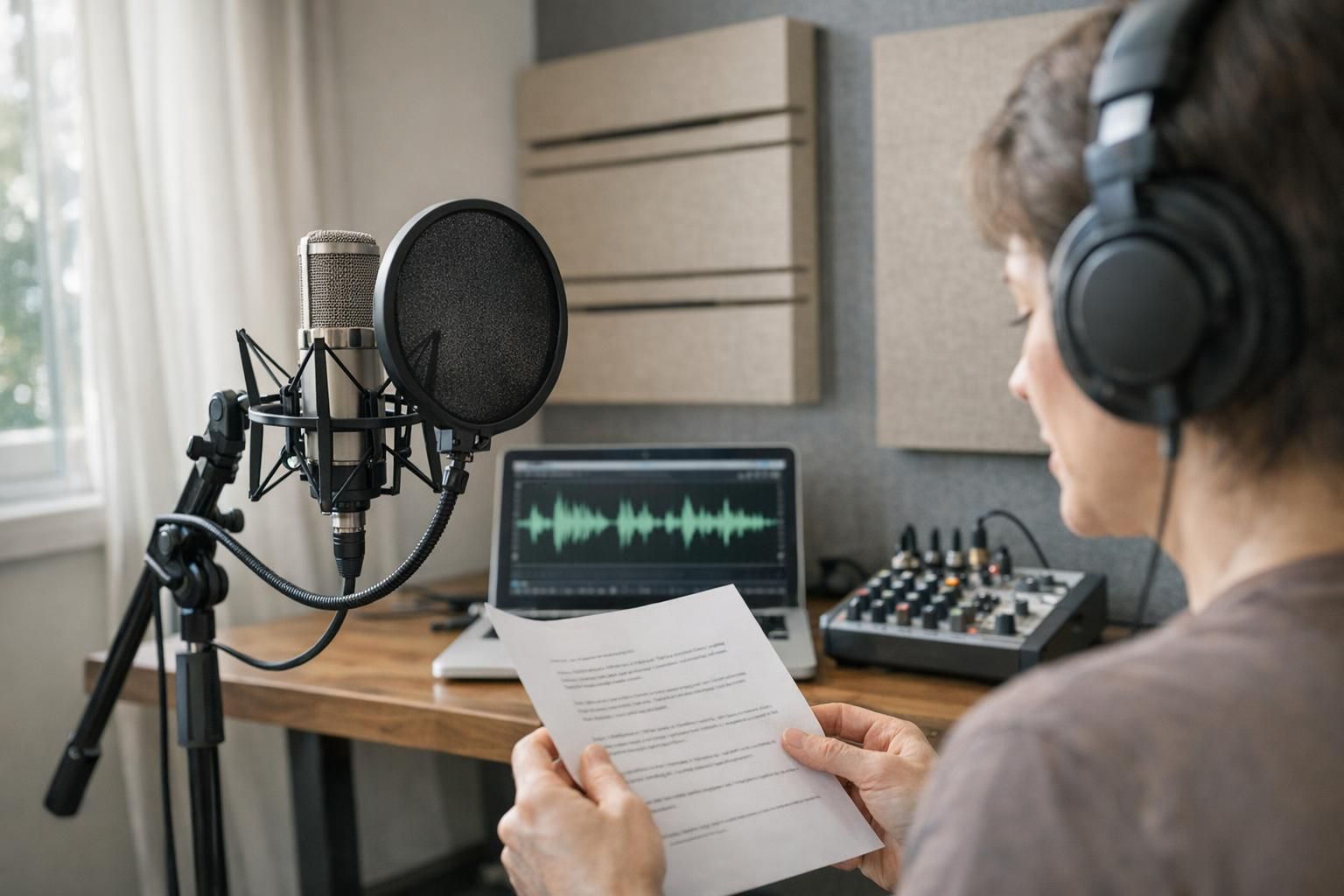
Voice over explainer is a voice-over narration that carries an explanatory film: it sets the pace, explains what happens and makes a complex service understandable without the viewer losing track.
The most important points in brief
- A good voice over explainer starts with what the viewer needs to understand, not with what you want to say.
- Scripts and the speaker must be built to land even without prior knowledge: short sentences, clear words, one statement per sentence.
- Common mistake in product teams is to cram in too much: the result is that nothing sticks.
What a voice over explainer should solve (for product teams)
When you explain a complex service you often have two problems at once: the service is hard to summarize and the audience is impatient. They may give you 20–40 seconds before they mentally disengage.
A voice over explainer should therefore do three things in the right order:
- Set context: who the film is for and what problem is to be solved.
- Show the mechanics: how it works, but only at the level needed to understand the value.
- Make the next step easy: what to do after the film (book a demo, start a test, talk to sales, etc.).
If you skip the context the rest becomes “tech”. If you go too deep into the mechanics you lose the one who is just trying to understand whether this is relevant. This is often where the message doesn’t land: you say the right things, but in the wrong order and with the wrong density.
What distinguishes an understandable explainer from “we tried to say everything”
In real projects I see the same pattern: product and market teams want to be correct, comprehensive and cautious. It sounds reasonable, but it leads to scripts that pile up conditions, disclaimers and jargon. The viewer doesn’t follow, even though the content is “right”.
An understandable voice over explainer does the opposite:
- Chooses a line: a main point that everything else supports.
- Builds on examples: “this is what it looks like in practice”, not “the platform enables”.
- Prioritizes clarity over precision: you can be exact in sales decks and documentation. The film’s job is to create understanding.
This is also the way to get the message to land across multiple audiences without trying to write “for everyone”. When you make the core clear, more people tend to recognize themselves, not fewer.
Script: the part you can’t “save in post”
Voice over explainer sounds simple: “we write a script and record it.” But the script is the bottleneck. If the script is unclear, a good speaker doesn’t help. And if the script is too long, speaking faster doesn’t help.
Three script rules that make a difference:
- One thought per sentence. No double subordinate clauses. No parenthetical logic.
- Concrete verbs. “You see”, “you choose”, “the system matches”, “we send”. Fewer “enables”, “handles”, “supports”.
- Pacing: what is new needs air. What is obvious can go faster.
Roughly count: 130–150 words per minute for a Swedish explainer. If the film should be 60 seconds you have roughly 140 words to work with. This is usually a useful constraint for product teams who want to include everything.
Speaker and tone: the choice that drives trust
For a complex service, voice over isn’t only about “sounding good.” It should sound like someone who understands the topic and respects the viewer’s time.
Some practical choices that affect how you’re perceived:
- Tempo: too fast is experienced as stress or “pitch”. Too slow feels like an educational video from 2008.
- Emphasis: emphasize verbs and key words, not disclaimers and subordinate clauses.
- Warmth vs. factuality: many B2B services benefit from being factual and calm, but with human presence. Over-enthusiasm often makes the content less credible.
If you’re unsure: listen to three different voices on demos and decide what fits your service. Not what sounds professional in general, but what matches your product and your target audience’s expectations.
Structure template
Use this structure to reduce the risk that you write a script that sounds reasonable internally but is not digestible for anyone outside the team. It forces prioritization and the right order.
- Viewer question (one sentence): “After the film, the viewer should understand X and be able to take step Y.”
- Main point (one sentence): the single most important thing about the service.
- Part 1 — Problem/context (~15 sec): who is this for, what is the problem?
- Part 2 — How it works (~30 sec): the mechanics at the level needed to understand value, not features.
- Part 3 — Result + next step (~15 sec): what happens, what should the viewer do now?
- Total length: 45–90 seconds. If longer, define a clear motivation anchor.
Process / checklist
- Set a clear viewer question: “After the film, the viewer should understand X and be able to take step Y.” Write it down in one sentence.
- Choose a main point: if you could only say one thing about the service, what is it? Everything else becomes support.
- Sketch three parts: 1) problem/context, 2) how it works at a high level, 3) results + next steps.
- Write for the ear: short sentences, active verbs, no lists that must “be remembered”.
- Read aloud and cut: anything that feels like a side note should be removed or moved to another channel.
- Test with someone outside the team: have the person retell in their own words. If they get stuck: it’s the script, not the person.
- Choose a speaker based on content: match the tone and pace to how complex the service is and how much trust you need to build.
- Lock in length and purpose: 45–90 seconds is often enough. Longer requires a clearly defined motivation anchor.
Next steps
If you’re going to explain a complex service: use the structure template above and stick to a single main point. When you have a script of the right length you can decide on the speaker (voice, tempo, tone) and whether you need one or more versions for different audiences. Many explainers are part of a larger corporate video production -- read more about corporate voice over if that is your case.
If you want to discuss script or voice choices before you invest time in production, contact via contact.
FAQ
How do we know the message is actually getting through?
Let two people outside the team listen and recount. If they can’t say what the service does and for whom after, you must simplify and cut, not add more.
How long should a voice over explainer be for a complex service?
Often 60–90 seconds. Under 60 seconds becomes too thin, over 90 requires that the viewer is already warmed up.
Should we mention all features or keep it at a high level?
High level. Choose 1–2 concrete examples that represent the whole. Features belong in a demo, not in the explainer.
Can we use the same explainer for multiple audiences?
Sometimes, if the problem picture is the same. If the audiences have different “why,” you often need different intros and different examples, even if the service is the same.
What is the most common mistake product teams make in the script?
They write as in a specification: too much context, too many conditions, too many concepts. An explainer must be simpler than internal logic.
Read more: