
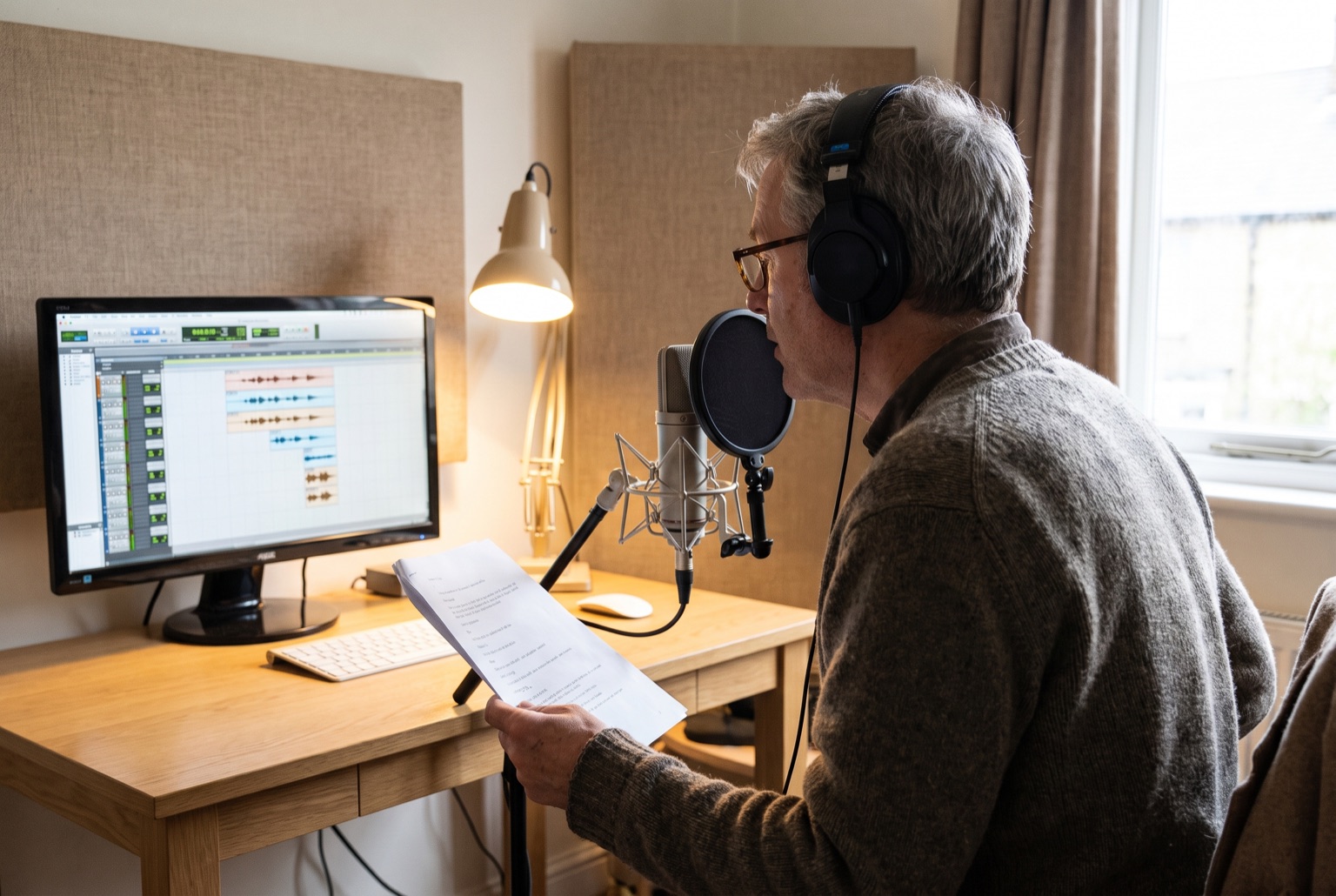
A 30-second radio spot takes about 15 minutes to record. On a good day it takes 30 seconds. That is true, and it is not the whole answer to what you are paying for.
The essentials in brief
- The recording itself is short. The price reflects the experience that makes it short, plus the rights.
- You are buying a voice, not a finished spot. Music, sound design and the mix sit with your production company or agency.
- A campaign in 30, 20, 15 and 10 seconds is sometimes four recordings and sometimes one, depending on whether the message differs.
- A TV read can be reused for radio if the script and the length are identical. Otherwise it is a new recording.
- What usually causes friction is a script that does not fit the time.
A 30-second spot takes 15 minutes
I used to call myself one shot Mattias. It was not entirely made up. With a sensible script and a clear tone, a thirty-second spot can be done in thirty seconds.
I have grown fussier with the years. These days I would rather lay down a few extra takes and choose between them, so realistically a spot lands at around fifteen minutes from sitting down to delivering the file.
That number tends to surprise people. It is also what makes the price question feel awkward: how can a quarter of an hour's work cost that?
The answer is that the quarter of an hour is the result, not the work. It takes fifteen minutes because I have been doing this for forty years. An inexperienced voice would have needed three hours on the same script and still missed the tone, and someone would have paid for those three hours instead. You are paying for it to be quick and right the first time, and for the right to use the result.
What you are actually buying
This is worth being explicit about, because it is often misunderstood at the quoting stage: I deliver voice, not a finished product.
You get recorded and edited voice over in the correct format. Music, sound effects, the mix and the final mastering against the station's requirements sit with your production company or agency. Some people expect a finished spot when they order "a radio ad" and are surprised when what arrives is a dry voice file.
That is not a limitation, it is the division of labour. The sound designer wants a clean voice to work with, not something that has already been processed. More on delivery formats in WAV 48 kHz 24-bit and clear file names.
The other half of the price is the rights: which channels, which market and for how long. Radio and TV are normally handled more strictly than web. See voice over rights for how that is set.
The versions: 30, 20, 15 and 10 seconds
A radio campaign is rarely run in a single length. Most often the same message exists in several edit lengths, and the question becomes whether that is one recording or four.
It depends on the message.
If the copy differs between versions they have to be read separately. A fifteen-second spot with a different offer from the thirty is simply a different script.
If it is the same message in shorter form there is often a smarter route. I can keep the opening and the close and only re-read the middle section, so the short versions sit tonally with the original. It sounds more coherent than recording everything again, and it is quicker.
Say which lengths you need in the order. There is a difference between planning four versions from the start and discovering the need after the session is finished.
The weekly rhythm of a running campaign
The most common form of recurring advertising work looks roughly like this: the client gets in touch early in the week, says which versions apply, I record and deliver the same day.
I have run that model with Power for two years, one recording a week. Sometimes they come with two weeks at once when they know what is going out. Because I have my own studio there is no session booking to juggle, which is the whole point of the arrangement: what would be a logistics problem becomes an email.
It relies on the framework being set once. When everyone agrees on what is being bought and sold, an arrangement like that runs for years without friction.
Can the TV read be reused for radio?
Yes, if the script and the length are the same. Identical copy at identical length is not a new recording, it is a rights question: does the licence cover radio as well, or only TV?
If the script differs, or a thirty-second read has to become a fifteen, it is a new recording. That is not the same as trimming an existing file, because the emphasis and pacing have to follow the new length.
Why do ads sound louder than the programme?
This irritates listeners, and the explanation is partly technical.
Radio stations run compression at the transmitter to hold an even level across the broadcast. The problem arises when the advert is already heavily compressed by the time it reaches the station. The transmitter compressors then have nothing left to work with, and the spot is perceived as louder than the programming around it. On top of that, some mixes deliberately push adverts high so they cut through.
It should be said that this is how I have understood it from the recording side over forty years in the business. Exactly how any given station has configured its broadcast chain is a question for them.
The practical consequence for you as a buyer is the same either way: do not ask for a pre-compressed voice file. Leave the dynamics to whoever does the mix, so there is something left to work with.
What usually causes friction
Almost always the same thing: the script does not fit the time.
The agency wants the whole offer, all the terms and a closing call to action, and it has to fit in fifteen seconds. You can speak quickly, but there is a threshold where it stops sounding like communication and starts sounding like the small print.
Normal conversational pace is around 130 to 150 words per minute. A fifteen-second spot therefore holds roughly 35 words if it is to sound relaxed, and up to 45 if it has to move. I can read at 180 words per minute and will when it is needed, but it shows, and that is rarely what you want in a sales message.
Count the words before the session rather than discovering the problem in the booth.
Send the script in advance and I will tell you whether it fits, and where it can be cut.
Next steps
If you are producing radio advertising and want to know what the voice costs: send the script or the word count, the lengths you need, and where the spot will run. You get a fixed price with production and rights on separate lines.
See rates for guide figures, radio voice over for the service, or get in touch via contact.
FAQ
How long does it take to record a radio spot?
About 15 minutes for a 30-second spot, from sitting down to delivering the file. More versions take longer. The reading time is rarely the bottleneck; the number of versions and how settled the script is matter more.
Are music and sound design included?
No. I deliver voice in the correct format. Music, effects and the final mix are done by your production company or agency. If you want a finished spot you need a sound producer in addition to the voice.
We need 30, 20 and 15 seconds. Is that three prices?
It depends on whether the message differs. Different copy means three recordings. The same message in shorter form can often keep the opening and close with only the middle re-read, which is simpler and cheaper. State the lengths you need in the enquiry.
Can we use the same recording for both TV and radio?
If the script and length are identical it is not a new recording, but it is a licensing question. Check that the rights cover both channels. If the script or length differs it is a new recording.
How many words fit in a 15-second spot?
Around 35 words at a relaxed conversational pace, up to 45 if it has to move. I can manage 180 words per minute, but then it sounds pressed. Send the script in advance and I will tell you whether it holds.
Why does a quarter of an hour's recording cost what it does?
Because the quarter of an hour is the product of long experience, not the measure of the work. The price reflects getting it right immediately, plus the rights to use the material in the channel and period you have chosen.
Read more: