
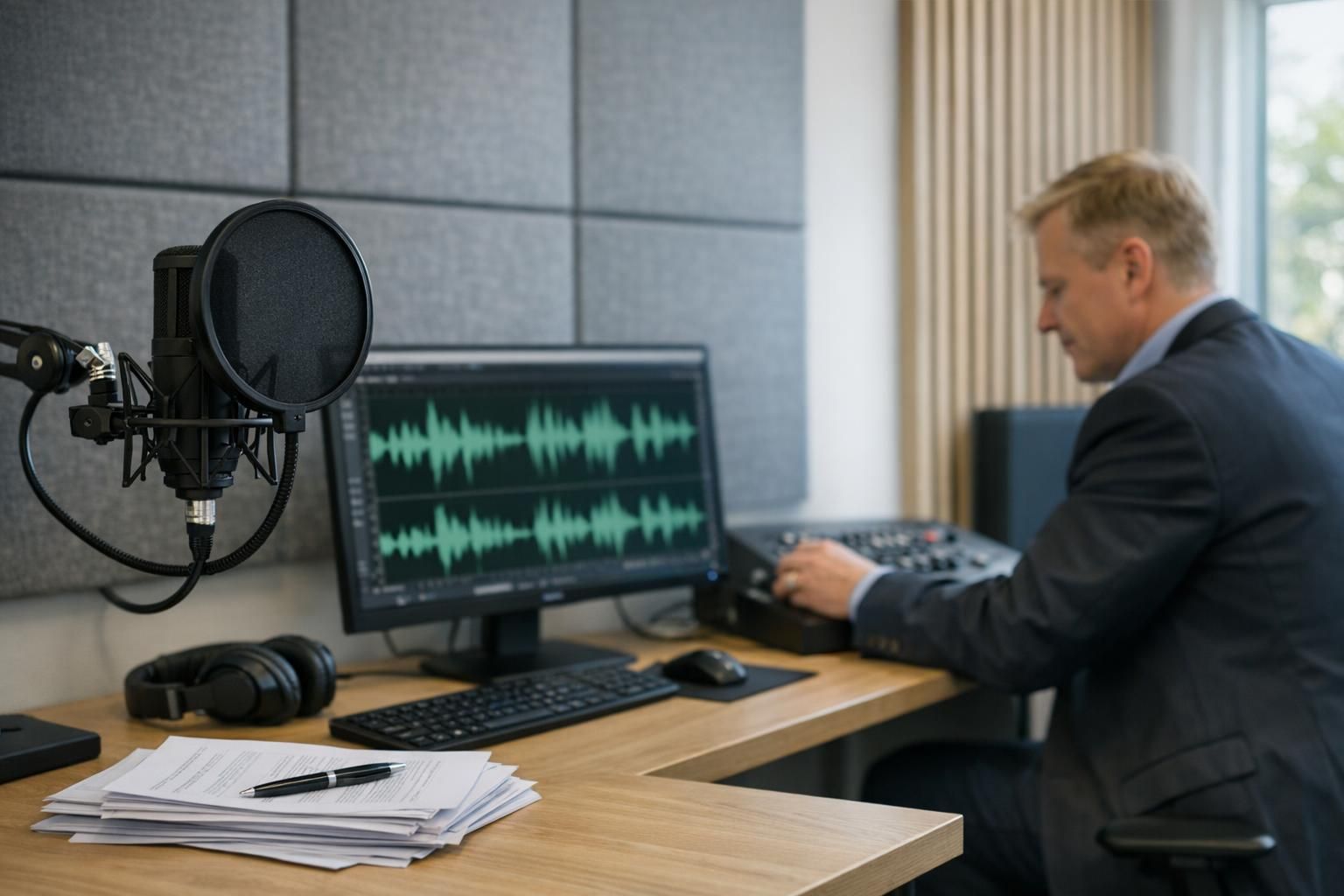
You work in government, a public agency, a municipality or a state-owned enterprise, and you need voice over. Maybe for a training film, an information campaign or e-learning. You know you need a voice — but you're not sure how it works with procurement rules, purchase orders and all the administrative requirements that come with public sector work. This guide is written for you.
Key points at a glance
- Most voice over orders fall below direct procurement thresholds in most countries, meaning no formal tender is required.
- A clear brief with purpose, target audience, tone and usage area makes the process smoother for everyone.
- Delivery format, archiving and accessibility should be specified in the order from the start.
- Pricing is transparent — ask for an itemised quote and compare with the market.
- Working with a voice artist experienced in public sector projects saves time on administration.
Procurement: what actually applies?
This is the part that makes public sector buyers nervous. Procurement rules. Tender requirements. Framework agreements. But in most cases, a voice over order is simpler than you think.
Direct procurement thresholds
Most countries have thresholds below which public organisations can make direct purchases without a formal tender process. The logic is the same everywhere: for smaller purchases, the administrative cost of a full procurement process outweighs the benefit.
In Sweden (where I'm based), the thresholds under LOU (the Public Procurement Act) are:
- Central government authorities: approximately 700 000 SEK (roughly 60 000 EUR) excl. VAT.
- Other contracting authorities (municipalities, regions, state-owned companies): approximately 1 200 000 SEK (roughly 105 000 EUR) excl. VAT.
In the EU, similar thresholds exist under EU procurement directives. The principles are comparable: below a certain amount, simplified or direct procurement is permitted.
A typical voice over order — say, recording an e-learning series of ten modules — usually totals 3 000–8 000 EUR. That's well below direct procurement thresholds in virtually every country.
What you should still do:
- Document the selection. Write a brief justification for why you chose this particular artist. "We listened to demos from three artists and selected the one whose tone best matched our brand" is sufficient.
- Verify tax compliance. Ensure the supplier is properly registered for tax purposes in their country. In Sweden, this means checking the F-tax register (F-skattsedel) with the Swedish Tax Agency.
- Don't bundle orders unintentionally. If you order voice over three times in one year from the same supplier, the total amount counts. Plan accordingly.
When the amount exceeds the threshold
Large projects — for example, a nationwide information campaign with voice over in TV, radio and digital — can exceed direct procurement thresholds. Then simplified or open procurement applies. Contact your procurement unit early. They can help you formulate the requirements specification correctly.
Tip: include a "test recording" as part of the procurement. This gives you the opportunity to assess voice character, not just price.
Framework agreements
Some public organisations have framework agreements for communication services that include voice over. Check with your procurement or purchasing department. If a framework agreement exists, you should use it — but verify that the suppliers in the agreement actually offer voice over and that the quality meets your needs.
How to write a brief that works
Public sector organisations often have internal templates and processes. But a voice over brief doesn't need to be complicated. It needs to be clear.
What your brief should include
- Purpose. What will the recording be used for? Training, information, campaign?
- Target audience. Who will listen? Citizens? Employees? A specific professional group?
- Tone and style. Formal, friendly, neutral? Provide reference examples if possible — "think BBC documentary narrator, but slightly warmer."
- Script. Attach the script. If it's not finished, indicate approximate length.
- Usage area. Website, intranet, social media, broadcast? This affects the price.
- Delivery format. WAV, MP3, specific sample rate? Check with the person who will edit the material.
- Delivery date. When do you need the material?
- Budget. Not essential to state, but it helps the artist tailor the quote.
- Accessibility. Does the material need to be accompanied by subtitles? Should the text be available in alternative formats?
- Language. If you need Swedish voice over for an international organisation, specify whether it should be standard Swedish or if a particular register is needed.
Example of a brief
We need a male voice (35–50 years, standard Swedish) for a training film about information security. The film is aimed at regional employees. The tone should be friendly and clear, not formal. Script: 1 200 words (attached). Usage: intranet and Teams. Delivery format: WAV 48kHz/24-bit. Deadline: 15 May. Budget: max 800 EUR incl. VAT.
That brief takes five minutes to write and saves hours in the process.
Purchase orders and invoicing
Public sector organisations typically require a PO number (Purchase Order) on the invoice. Communicate this to the supplier at the time of ordering — not after delivery. This prevents the invoice from bouncing in your finance system.
Common invoicing requirements
- Organisation number or registration number on the invoice.
- PO number or order reference.
- Itemisation: number of minutes, type of usage, any additional services.
- Tax compliance documentation — reference to relevant tax registration.
- E-invoicing. Increasingly, public organisations require electronic invoicing (Peppol BIS in the EU, various standards elsewhere). Check whether your organisation requires it and inform the supplier.
Most professional voice over artists with public sector experience know how this works. If you're unsure — ask. Better to clarify the invoice format before than to need corrections afterwards.
Pricing and transparency
Public sector expects transparent pricing. That's reasonable. Here's what you can expect.
Typical prices for public sector projects
- Training film, 5 minutes: 400–700 EUR.
- E-learning, 10 modules of 3 minutes each: 2 500–5 000 EUR.
- Information campaign, 30 seconds, digital: 500–1 000 EUR.
- IVR/phone system, 15 menu prompts: 350–600 EUR.
- Accessibility-adapted information, 10 minutes: 500–900 EUR.
Prices include recording and one to two correction rounds. Usage rights for public sector operations (internal and external, non-commercial) are typically included in the base price. If the material is to be used commercially (resold, licensed), additional rights fees apply.
See the full rates page for detailed examples.
Comparing quotes
When comparing quotes from different voice artists, make sure you're comparing like with like:
- Are usage rights included or separate?
- How many correction rounds are included?
- What delivery format is included?
- Is express delivery priced separately?
The cheapest quote isn't always the best value. A quote that includes usage rights, two correction rounds and delivery in multiple formats may be more cost-effective than a lower base price with add-ons.
Delivery format and quality
Standard formats
- WAV 48kHz/24-bit — for film and video production.
- WAV 44.1kHz/16-bit — for e-learning and web publishing.
- MP3 320kbps — for quick reviews and web publishing where file size matters.
File naming and structure
For larger orders (multiple modules, multiple speakers) — agree on a naming convention in advance. For example: module_01_part_a_en.wav. This saves time during editing and archiving.
Archiving
Public sector organisations often have archiving requirements. Save:
- Final audio material in original format (WAV).
- Approved script (PDF or Word).
- Quote and any agreement.
- Invoice documentation.
Keep in mind that voice over recordings may need to be updated if information changes. Save the artist's contact details and note the technical settings used (microphone, room, any post-processing) to facilitate future additions.
Accessibility
Public sector organisations have accessibility requirements under various national laws and the EU Web Accessibility Directive. This affects how you use voice over:
- Subtitles. If voice over is used in video, the video must have subtitles. The supplier can deliver a time-coded text file (SRT) as a basis.
- Transcription. If voice over is published as audio on the web, a text version should be available.
- Plain language. The script should be written in plain language. For public sector, this isn't just good practice — it's often a legal requirement.
Common project types
Training film
The most common assignment from public sector. Typical: a narrator voice guiding viewers through internal training on everything from IT security to workplace safety. Length: 3–15 minutes per module.
E-learning
Multi-module setups where the voice needs to be consistent throughout the series. Important detail: book the same artist for all modules. Switching voice mid-course disrupts learning.
Information campaign
Voice for film, animation or radio spots in connection with public information. Think election campaigns, public health campaigns, traffic safety. Extended usage rights are often required here.
IVR and phone system
Menus, greetings and information in phone systems. Needs regular updating. This is a common entry point for public sector voice over projects.
Accessibility-adapted information
Reading of brochures, reports or other information that should be available in audio format for people with visual impairments. Requires a voice that is particularly clear and well-structured.
Timeline: what's realistic?
A typical public sector order follows roughly this timeline:
| Step | Time |
|---|---|
| Brief and quote | 1–3 business days |
| Internal approval | 1–5 business days (depends on your organisation) |
| Script proofreading | 1–2 business days |
| Recording | 1–2 business days |
| Delivery and review | 1–2 business days |
| Any corrections | 1–2 business days |
Total time: approximately 7–15 business days from first contact to approved delivery. The biggest delay almost always happens internally — approvals, script changes and reprioritisations. Plan early.
Working across borders
If your public sector organisation is based outside Sweden and you want to hire a Swedish voice artist, the process is essentially the same. The main differences:
- Time zone. Sweden is CET/CEST. Factor this into your timeline.
- Payment. International bank transfer is standard. Discuss currency (SEK, EUR or USD) upfront.
- Tax documentation. Depending on your country, you may need specific tax documentation for cross-border services within the EU (reverse charge mechanism) or certificates of tax residency.
Since 1985, I've worked with public sector clients across Scandinavia and Europe. The administrative requirements vary, but the core process is the same: clear brief, transparent pricing, professional delivery.
FAQ
Do we need to run a formal procurement for voice over?
In most cases, no — the amount falls below the direct procurement threshold. Document your selection and verify tax compliance. If the amount exceeds the threshold, contact your procurement unit.
Can we use the recording for as long as we want?
It depends on the agreement. Standard for public sector is typically unlimited use in time for non-commercial purposes. Clarify this in the quote.
What happens if the script changes after recording?
You order a new recording of the changed sections. This costs extra, but usually less than the original recording because the artist already knows the project.
Can we get a test recording before we decide?
Yes, many artists offer a short test recording (30–60 seconds) for free or at a reduced price. This gives you the opportunity to assess the voice against your specific script.
Do we need a written contract?
An approved quote with specified terms functions as a contract. For larger orders, it may be wise to draw up a separate agreement covering rights, corrections and delivery terms. Your legal department may have a standard template.
How do we ensure we get the same quality for future orders?
Hire the same artist. Document technical settings. Save reference files. Four decades in the industry have taught me that consistency is built through relationship, not through specifications — but the specifications help.
Can you handle e-invoicing?
Yes. Most professional voice over artists who work with public sector are familiar with electronic invoicing requirements. Specify your requirements (Peppol BIS, specific format, routing ID) when placing the order.
Read more: