
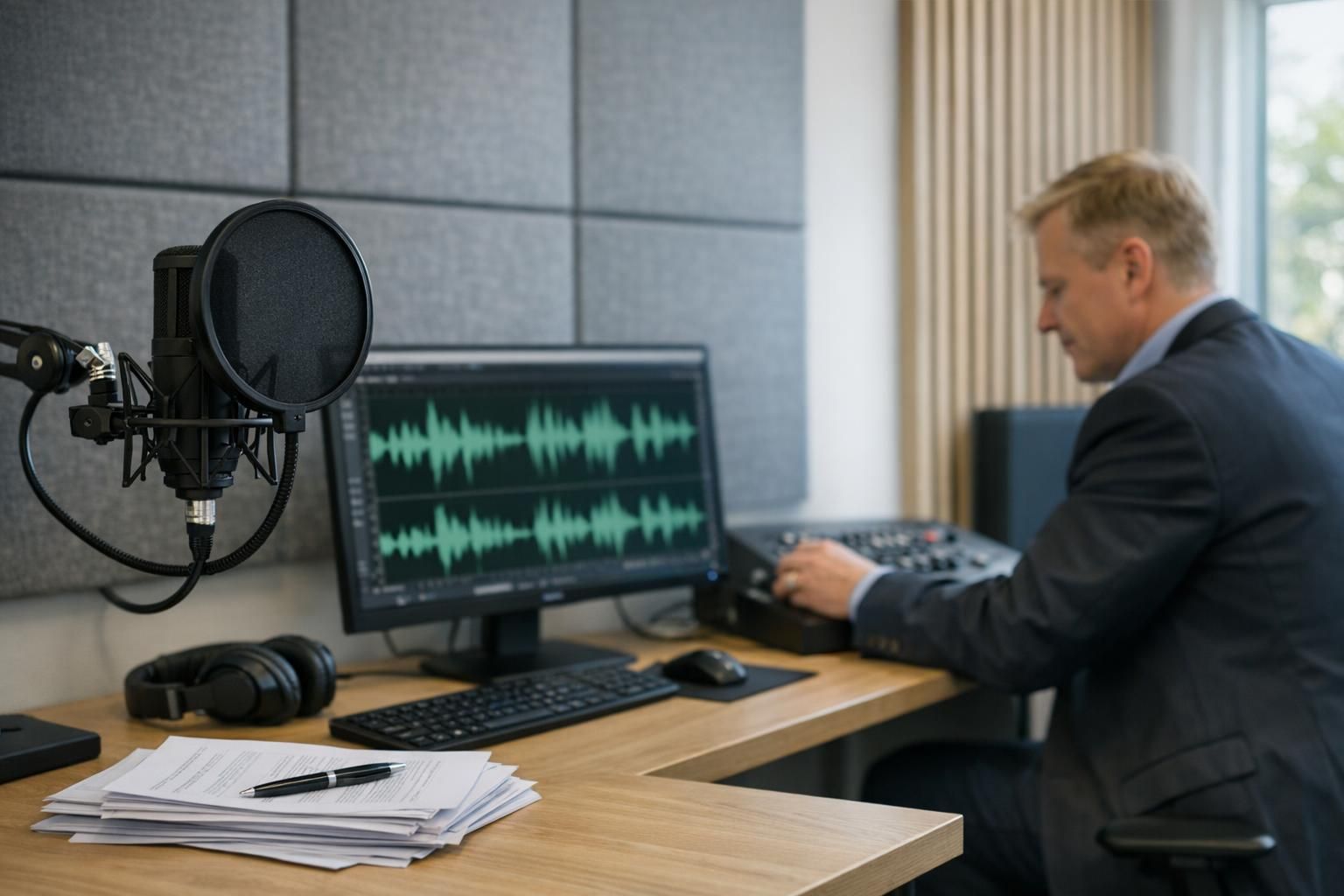
Voice over in the public sector is a recorded voice used in films, e-learning, telephone systems and information services, where the order needs to be verifiable with clear procurement and traceable documentation.
The most important points in brief
- What usually determines an order is not the voice, but unclear requirements: usage, rights, delivery format and approval process.
- Specify the license and the scope of use so that it can be followed up later (where, for how long, which channels, languages).
- Build a supporting folder from day one: manuscript version, decision log, copyright/AI requirements, and who approved what.
What needs to be procured
A recurring situation in the public sector: the organization wants a clear voice quickly, but procurement needs documentation that holds up if someone asks later. For voice over in the public sector there are three parts that must be crystal clear already in the requirements.
1) Scope. Number of minutes/words, number of versions, number of languages, whether there are special pronunciations (names, places, terminology) and whether timing should align with the visuals.
2) Delivery. File format (common are WAV 48 kHz/24-bit or 44.1/16), division (one file per scene, per telephone menu option, per module), file name standard and whether you need 'clean' (without mastering) or fully mixed.
3) Rights and use. Where the voice may be used (intranet, web, social channels, advertisements, telephone exchange, e-learning), for how long, and if you need the ability to reuse in future productions.
If any of these points are left open, it becomes difficult to compare bids and even harder to justify a deviation later. It is usually where the uncertainty arises, not in the actual choice of voice.
More about the setup for the public sector is here: public sector. If you are planning e-learning projects, see also e-learning voice over.
Common documentation mistakes (and how to avoid them)
It's easy to think that “we order a voice-over” is enough. In practice, the order needs to stand on its own even when the project team has changed.
Miss 1: Manuscript without version control. If the same document is emailed around and changed continuously, it becomes unclear what has actually been recorded. Solution: lock a recording version (e.g., v1.3) and reference it in the order. Also save any subsequent changes as separate change orders.
Miss 2: Unclear approval process. “We listen and will get back to you” sounds harmless but often becomes a bottleneck. Establish a simple process: (1) read-through/tonal check, (2) recording, (3) proofreading/listening, (4) final approval. Indicate who is authorized to say “done”.
Miss 3: Rights that do not match the use. The classic: voice over ordered for an internal training but the clip ends up on an external website. Solution: describe the use as it can actually be, or make a clear split (internal/external) with separate terms.
Miss 4: Requirements that make comparison impossible. If the requirements are “professional voice with a warm tone,” the evaluation becomes easily subjective. Better: specify examples of reference clips as style guidance, and measurable requirements (number of proofreading rounds included, delivery time, file format, language, availability for pickup).
Miss 5: Lack of clarity regarding AI and synthetic voices. In some projects it is crucial that the voice is a human and not used for training. If it is a requirement, it needs to be stated explicitly in the request and in the contract terms.
How to write requirements that hold up under formal review
You want to be able to point to a section in the documentation and say: “This was the requirement, this was delivered, this was approved.” It is a different logic than creative orders in the private sector.
Practical way to formulate requirements for voice over in the public sector:
- Delivery object: “Recording of manuscript X (version Y) in Swedish, estimated length N minutes. Files delivered as WAV 48 kHz/24-bit, one file per chapter according to the file name standard.”
- Quality: “Recorded in a controlled studio, with no audible background noise. Even level between files.”
- Process: “A read-through of 30–60 seconds for tone before full recording. Two proofreading rounds are included, defined as changes in pronunciation/timing without manuscript changes.”
- Handle manuscript changes: “Changes after the locked recording manuscript are priced per minute/word and delivered as pickup within X business days.”
- Rights: “Usage: (channels). Duration: (e.g. 36 months). Geographic scope: (e.g. Sweden). Archive rights: right to store and republish the material in the agency's documentation.”
- Evaluation: “Price weighted against delivery ability (lead time), clarity in rights terms and quality in read-through against the given reference style.”
This does two things: you get comparable responses and you reduce the need for interpretation. It is often interpretation that creates concern later.
Process / checklist
- Lock the manuscript version: name and archive the recording manuscript.
- Describe usage and rights: channels, duration, any restrictions (e.g., no AI training).
- Set delivery requirements: format, file structure, name standard, whether mix/master should be included.
- Define corrections: number of rounds and what counts as a manuscript change.
- Proofread: brief test for tone/pronunciation before full recording.
- Approval: who approves, within what time, and where the decision is documented.
- Traceability: save the quote, order, delivery, approval and any pickup orders in the same case folder.
Next steps
If you are going to place a formal order: use the documentation checklist and fill in the three parts (scope, delivery, rights) before you send anything to the supplier. When that is done you can request a read-through and price for a clearly defined delivery, instead of “start creatively” and document afterwards.
If you want to check whether your requirements text is sufficiently clear to compare responses and avoid post-discussions: contact
FAQ
Do we need to specify rights for an internal training film?
Yes. “Internal” tends to drift over time (new platform, external sharing, onboarding for consultants). State where it may reside and for how long, so you don't have to guess later.
How do we avoid the order being judged as subjective?
Make the requirements measurable: delivery format, lead time, number of proofreading rounds, read-through included, and describe the style with 1–2 clear references instead of vague terms.
What counts as a proofreading round?
Correct pronunciation, emphasis and timing based on the same manuscript. If you change the manuscript after locking, it is a change, not a proofreading.
Can we require that the voice not be used for AI training?
Yes, but write it as an explicit condition in the request and in the contract terms. Otherwise it becomes difficult to enforce.
How much documentation do we need to keep to feel secure in a post-audit check?
Manuscript version, quotation and order, delivery specification, approval (who and when) and any changes/pickups. It goes a long way if it is consistent.
Read more: