
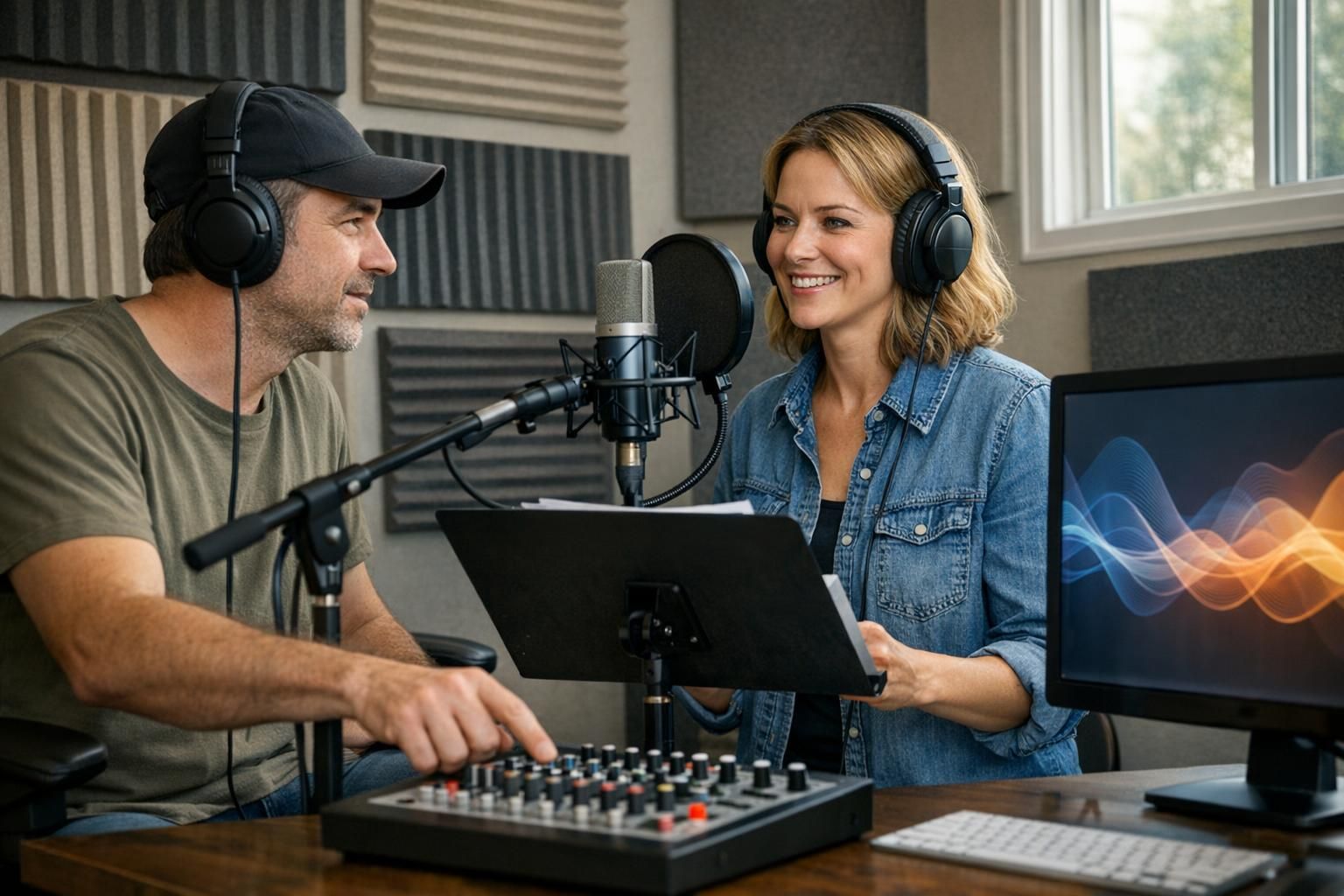
A voice-over brief is the information that enables the right voice, the right tone, and the right delivery to be recorded without retakes.
The most important points, in brief
- Most retakes do not come from the 'wrong voice' but from a brief that leaves room for interpretation.
- Five recurring mistakes: unclear goal, no audience/channel, unclear pronunciation, lack of timing/format, and feedback too late.
- A good brief should be understandable by someone who has not been involved in the project.
1) You describe mood, but not purpose
"Warm, safe, premium" are common words in briefs. The problem is that they say very little about what the voice should accomplish. In practice, the same words can lead to three completely different readings depending on whether the film should drive clicks, explain something, or simply build recognition.
What is often missing is a simple sentence about the goal of the piece. Example: "Get the viewer to understand the offer in 15 seconds and feel that it is easy to get started." When the purpose is clear, tempo, emphasis and energy also become easier to hit.
This is often the difference between a take that sounds good and a take that works in the edit. For agencies, it often leads to less internal ping-pong and fewer rounds with the client.
2) You lack context: where is the voice used and what happens on screen?
Many briefs are sent as a script in an email. Nothing more. Then voice-over becomes a guessing game: are we speaking over product images, a case film with interview clips, or a pure text video?
The voice must align with the pace of the visuals, music, graphical messages and pauses. If it's a social cutdown with tight cuts and text overlays, reading often needs to be tighter and more distinct than in a longer explainer video.
My experience from productions is that 'we'll send the film later' almost always ends with at least one correction: either the VO is too far forward (clashes with graphics) or too far back (doesn't sit against the music). A simple link to rough cut, storyboard or reference clip goes a long way.
3) Pronunciation and names are left open
This is a classic on the list of voice-over brief mistakes: product names, people, places and English terms without pronunciation guidance. It may sound like a detail, but it's one of the most costly details to miss because it is often discovered late (when someone on the client side hears it wrong).
If you have a brand pronunciation: spell it phonetically and give an example. If you don't know: decide it before recording. Say it as you think is not an option if you want to avoid retakes.
Practical tip: mark all risk words in the script (proper names, abbreviations, numbers, English terms) and write the pronunciation in parentheses directly after the first occurrence. That way you avoid separate documents that get forgotten.
4) Timing, format and technical requirements are unclear
"It should be 30 seconds" is not the same as the script being timed to 30 seconds. Agencies often end up in a situation where the script sounds good on paper but ends up 36 seconds in recording, especially if there are natural pauses or bullet lists.
If you want to avoid retakes, you need to be clear about:
- exact length per version (e.g., 6s, 15s, 30s) and whether there is a plus/minus range
- what type of delivery you need (mono/stereo, file format, level requirements if you have them, separate takes or a cohesive version)
- whether there should be space for graphics (and where)
What often works in practice is to do rough timing on the script beforehand: read aloud with roughly the right tempo and time it. It takes five minutes and often saves an extra recording round.
5) Feedback comes too late or from too many sources
It's perfectly reasonable for several people to give input. But if the feedback comes after recording and includes new directions (less sales, more energy, can we make it younger?) it quickly becomes costly in time and money.
What tends to work best is to lock three things before recording:
- a clear timeline for when feedback should be in
- a single person who collects and prioritizes (so VO doesn't receive conflicting instructions)
- a concrete reference for tone (one voice, a commercial, a sound sample)
I often see agencies that do this get it right on the first take even when the client is picky, precisely because you have aligned the scope of interpretation beforehand.
Process / checklist
- Write the purpose of the VO in one sentence (what should the viewer understand/feel/do?).
- Send context: rough cut/storyboard/reference and indicate channel (SoMe, web, event, TV, internal).
- Mark pronunciations: proper names, abbreviations, numbers, English terms (phonetic + example).
- Define timing and versions: exact seconds, plus/minus, and where you need pauses for graphics.
- Set feedback flow: a responsible person, deadline for input, and a tonal reference that everyone accepts.
Next steps
If you want to reduce the risk of retakes: take your latest brief and compare it against the checklist above. It usually takes only a moment to see where the brief leaves room for interpretation. When you have a version you can stand behind internally, you can send it together with the script and any references. If you need voice samples to lock the tone early, go via demos. Is the brief for a corporate film? Read more about corporate voice over. If you want to discuss the brief before recording (to avoid ‘we’ll do it later’), contact me via contact.
FAQ
How detailed should a voice-over brief be without becoming a script for the director?
Detailed on the elements that can cause retakes: purpose, context, pronunciation, timing and feedback flow. Less detail on "tone words" if you cannot tie them to a reference.
We're in a hurry. What is the minimal that still reduces retakes?
Purpose in one sentence + a reference (link) + pronunciation of risk words + exact length. That often suffices to avoid the most common mistakes.
Who should approve tone before recording?
The person who owns the final deliverable to the client. If several want to give input: let one person collect and send a consolidated comment.
How do we handle the client changing their mind after the first recording?
Try to lock in the purpose and reference beforehand. If you know the client is uncertain, feel free to send a short tone sample of 1–2 sentences for alignment.
What is the most common reason the VO doesn't fit in the cut?
That the brief lacks visual context and timing. The script may be good, but without a rough cut/storyboard, pauses and emphasis are often wrong against graphics and music.
Read more: