
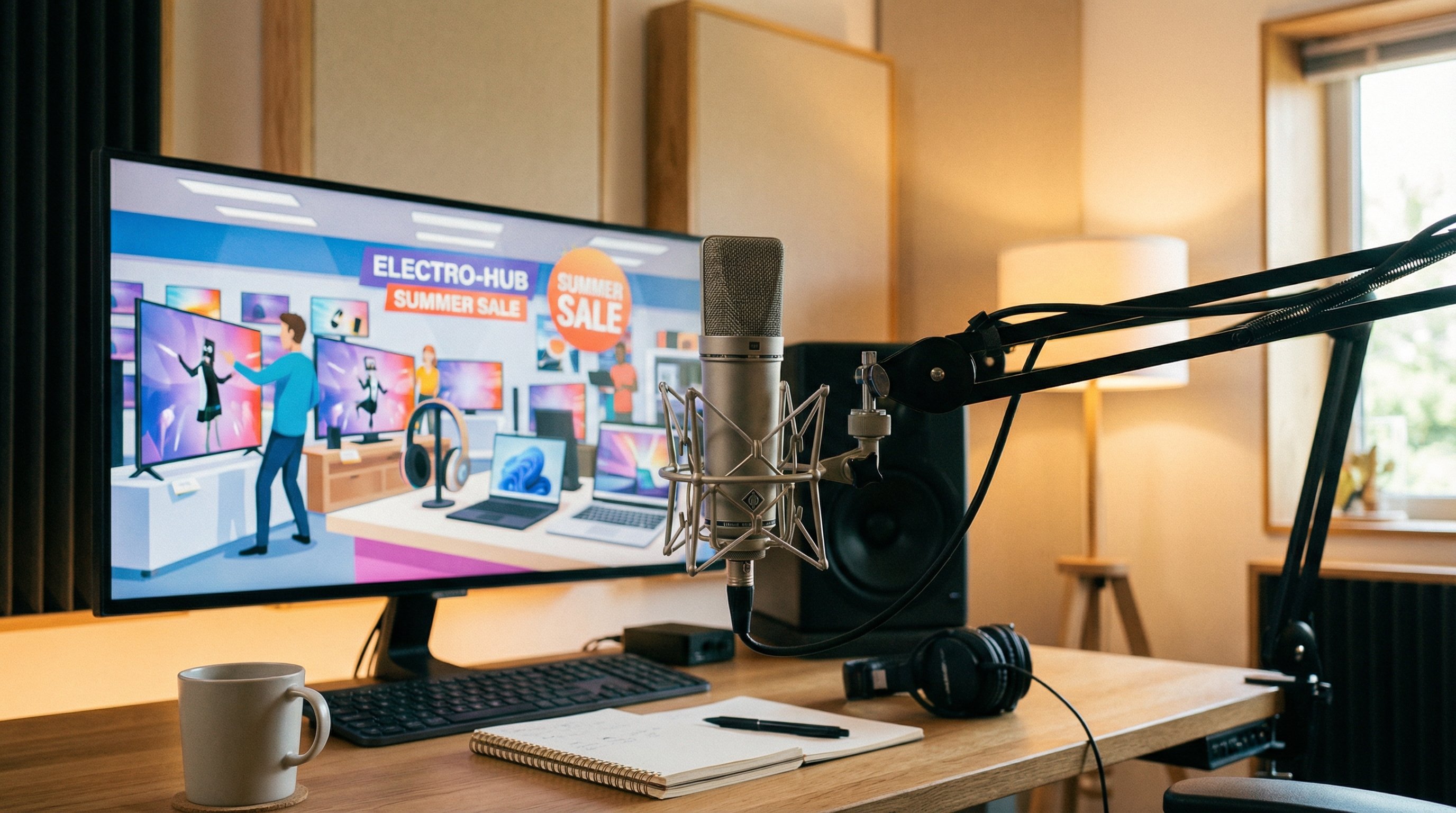
Since 2024, I've been recording voice over for Power every week — TV commercials, online video, campaign films. Over 100 recordings with the same voice, same pacing, same recognition. This is what a dedicated brand voice looks like in practice.
Key takeaways
- Power has used the same voice over artist (me) for over two years for their TV and online commercials.
- That means at least one recording per week — over 100 recordings in total.
- A dedicated voice builds auditory recognition that strengthens the brand at every touchpoint.
- Consistency requires an established workflow — not just a good voice.
From first recording to ongoing partnership
Power used a different voice before me. Exactly why they switched, I don't know — what I do know is that they stayed. Two years and counting.
The first assignment was like any other: a script, a brief, a delivery. But what happened next was that it became routine. Not complacency — an established flow where both parties know exactly what to expect.
I know how Power should sound. I know the pacing. I know which words need emphasis and which should glide past. That saves time on every recording, and you can hear it in the result.
What a dedicated voice actually means
It's not just about recognition — although that matters. Auditory recognition happens within 0.3 seconds. The viewer hears Power before they see the logo.
But it's equally about efficiency:
- No warm-up time — I don't need to "find the tone" each time
- Predictable delivery — Power knows exactly what they'll get and when
- Fewer revision rounds — when the voice already fits, adjustments are rarely needed
- Consistency across channels — same voice on TV, online, social media
A brand voice used consistently for two years creates an auditory signature that competitors cannot copy. It's one of the few marketing assets that gets stronger over time.
What it demands of me
One recording a week doesn't sound dramatic. But it has requirements:
- Availability — Power can't wait three days for a commercial that airs tomorrow
- Consistency — recording 100 must sound like recording 1
- Studio readiness — my studio needs to deliver broadcast quality with zero warm-up time
This is why a professional home studio with the right equipment and acoustics isn't a compromise — it's a prerequisite. I stand in my Isovox 2 at home and deliver the same quality as an external studio, with shorter lead times.
What the production agency says
<!-- PLACEHOLDER: Quote from Schjarven or Clockwork about the collaboration --> <!-- Suggested questions to ask:
- Why did you choose to keep the same voice?
- What has it meant for the production workflow?
- How do you notice the difference compared to using different voices? -->
[This section will be updated with a comment from the production agency.]
Why this matters if you're buying voice over
If you're considering voice over for recurring content — ad campaigns, product launches, social media — there's a choice to make early:
Do you switch voices each time, or do you build recognition?
Switching voices per project can work if each production is standalone. But if you want your audience to recognise your brand by voice — the way they do with a logo or a colour — you need consistency. And consistency requires a partnership that holds over time.
What I have with Power isn't a "booking relationship". It's a working relationship where both parties have invested in making it fast, reliable and high-quality every time.
FAQ
How long do you need to use the same voice to build recognition?
Research shows that auditory recognition happens after just a few exposures, but it strengthens significantly after 6–12 months of consistent use. Power has maintained it for over two years — and it shows.
Does it cost more to have a dedicated voice over artist?
Not necessarily. With an established workflow, the time per recording decreases, and fewer revision rounds save time. The total cost can end up lower than switching voices and rebriefing each time.
What happens if my dedicated voice can't deliver?
It's a fair question. Professional voice over artists plan for availability — my studio is always ready, and delivery within 24 hours is standard. But it requires choosing an artist who treats it as a commitment, not a side project.
Can an AI voice replace a dedicated brand voice?
Technically, partly. But an AI voice lacks the small adjustments that come from understanding the brand from the inside — the tonality that evolves over time, the intuitive sense of what "sounds like Power". That's hard to programme.
Read more: