
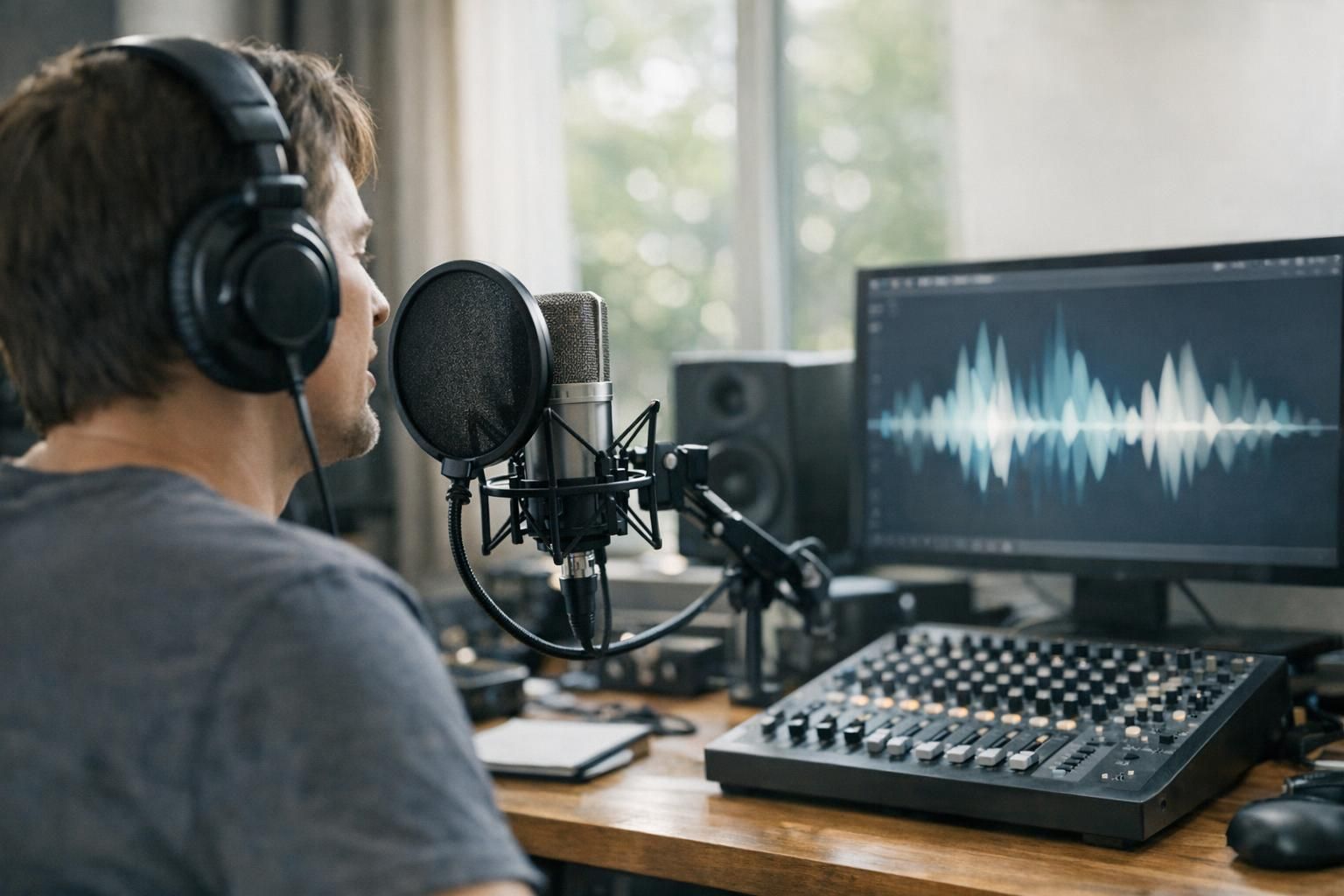
AI voice vs human voice is about choosing a voice solution based on risk, requirements for credibility, and how often the content will be changed.
Key points at a glance
- AI voice is usually appropriate when you need a lot of audio, frequently updated, and can tolerate slightly lower “human precision”.
- A human voice is usually the right choice when trust, nuance and brand feel are crucial (especially in first impressions).
- Mixing often works best: AI for volume and iteration, human for the edge and things that must not go wrong.
Why the question goes wrong if you only look at cost
I often see the same setup: someone calculates an AI solution as a cost saving against “a spokesperson voice.” It looks obvious in the calculation. Then comes the reality: legal wants consistent utterances of product names, support does not want to bear more misunderstandings, and someone in management does not want to explain to a customer why onboarding sound sounds like a robot.
The long-term mistake is rarely choosing AI or a human. It is that you lock yourself into the wrong thing: “cheaper per minute” instead of “cheaper per change” and “lower risk per publication.”
If you evaluate AI primarily to save money: calculate total cost over 12–24 months. Include internal time, rework, review, and the cost of correcting errors after publication. That’s where the difference tends to land.
When AI voice is the right choice
AI voice works well when the content is functional, repeatable and often changes. Examples I have seen work in practice:
- Product updates in apps and “what's new” flows where the text changes every sprint.
- Internal trainings where you want to iterate quickly and would rather update than re-record.
- Support and help center audio: short instructions, simple scenarios, many variants.
- Prototypes: get something that can be tested with users before you lock the script and tone.
But: AI still requires governance. Without a pronunciation list, style guide and a person who owns the quality, it becomes “cheap” in the wrong way. What tends to break the schedule is not the generation, but the corrections: words stressed incorrectly, names pronounced differently, or a tone that does not match how you actually sound.
When human voice is the right choice
Human voice is right when you need control over nuances, tempo, pauses and trust. Especially in situations where the listener makes a decision about you in a few seconds.
- Brand film, commercial voice over, landing pages with audio, and other direct contact.
- Onboarding for paying customers where trust and clarity reduce churn.
- Communication in sensitive topics: security, privacy, incidents, changes that affect customers.
- Content where the wrong tone costs more than you save: premium offerings, B2B enterprise, government-related.
This is also where management often underestimates the effect. It is not always “prettier.” It is fewer misunderstandings, fewer questions, and an experience that feels intentional. In several projects I have been involved in, human voice reduced the need to “explain afterwards” when something would otherwise land wrong.
Decision matrix: AI voice vs human voice
If you want to make a decision without getting stuck in opinions: use a simple decision matrix. Score each row 1–5 for your case and sum.
- Frequency of changes: often = AI, rarely = human
- Consequence if the tone/pronunciation goes wrong: high = human
- Need for variation (many versions/languages): high = AI or hybrid
- Need for brand presence: high = human
- Listening situation: stressed/complex = human, simple/standard = AI
- Internal capacity for quality control: low = human or fewer AI channels
- Asset lifespan: long = human is often worth it, short = AI
The point is not that the matrix “chooses for you.” The point is that you are forced to be clear where you take risk and where you do not.
Process / checklist
- List all use cases. Split into “customer-facing”, “internal”, “product”, “marketing”. You will almost always land on a mix.
- Set a quality level per area. What must be perfect, what can be “good enough”?
- Do a real A/B test on actual content. The same script, AI and human. Have 5–10 people listen and assess understandability and trust, not just “liked/disliked.”
- Plan governance. Who owns pronunciation, tone, versioning, and approvals? Without an owner, AI quickly becomes fragmented.
- Calculate over 12–24 months. Cost per change + internal time + risk cost. Not just cost per minute.
- Determine the hybrid boundary. Example: AI in help center and release notes, human in onboarding and campaigns.
Next steps
If you want to evaluate without locking yourself into the wrong option: choose two concrete areas (one high risk, one low), run a 2–3 week pilot, and set clear criteria for “approved.” If you want to compare costs in a way that holds in budget discussions, you can start by looking at rates and then gather your two use cases for a short check-in via contact.
FAQ
If we choose AI now, will we be stuck later?
Not if you separate the script, voice profile, and publishing flow from the supplier choice. Avoid embedding voice selection into product logic. Always save the original script and have a clear policy for pronunciation and style.
How much internal time does AI voice require in practice?
More than people think in the first month: pronunciation lists, adjustments and review. Once you have templates and routines it drops. But someone must own the quality on an ongoing basis.
What is the most common mistake when management wants to save money with AI?
That you change everything at once. It creates unnecessary rework costs and internal discussions. Start with low-risk areas and measure effect before moving customer-critical parts.
When do customers notice a difference between AI and human?
Usually in names, numbers, emphasis, and pauses. It’s rarely the voice timbre that decides, but small mistakes that make it feel less intentional.
Can we have the same voice in all channels if we run hybrid?
Partially. You can match the tone and pace, but it rarely becomes identical. I usually recommend limiting the “brand voices” to the areas where it matters, and letting AI be clearly functional.
Read more: